

Canvas guides
Box frame canvas prints. A little more presence.
By Your Image 2 Canvas
The YI2C journal · From our West Yorkshire workshop
A favourite photograph already means something. A carefully chosen wood frame gives it a little more weight on the wall.
A box frame canvas print is a stretched canvas with an outer wooden frame and a small gap between the two. Also called a floating frame or floater frame, it adds a defined edge while leaving the canvas texture visible. Our complete framed canvases start at £32.86 for A5, including VAT and standard UK delivery.
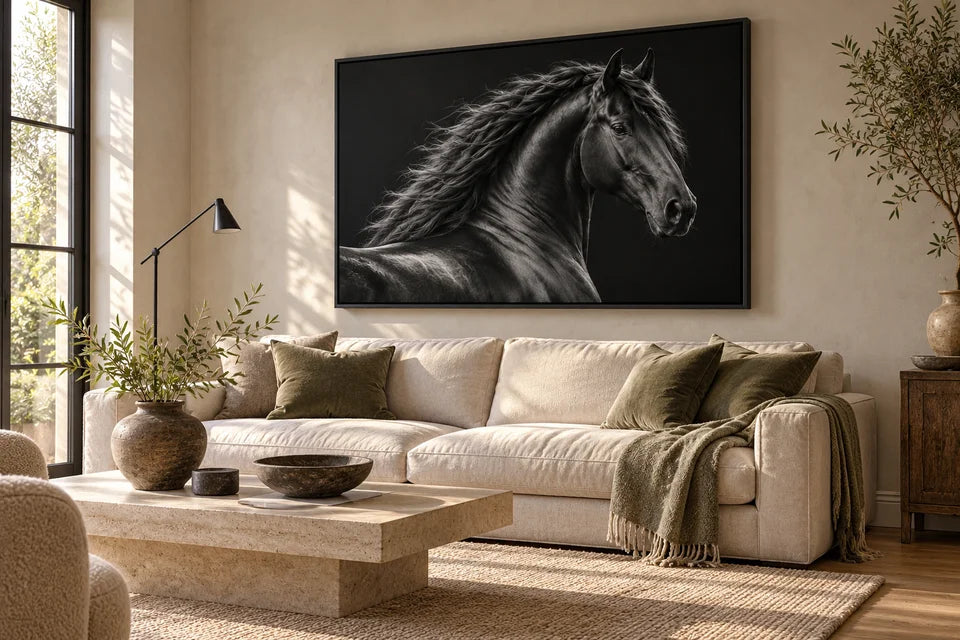
The room scenes in this feature are styled illustrations, including fictional family and wedding photographs. Workshop and finished-print photographs show our actual work. Room illustrations are styling ideas rather than exact size or colour proofs.
The detail that changes the picture
What does a floating frame add to a canvas?
There is a lovely moment when a finished canvas goes into its frame. The photograph is the same, but it suddenly has a clearer place of its own. That fine line around it can make a family photograph feel more considered, or give a bold piece of artwork the boundary it needs.
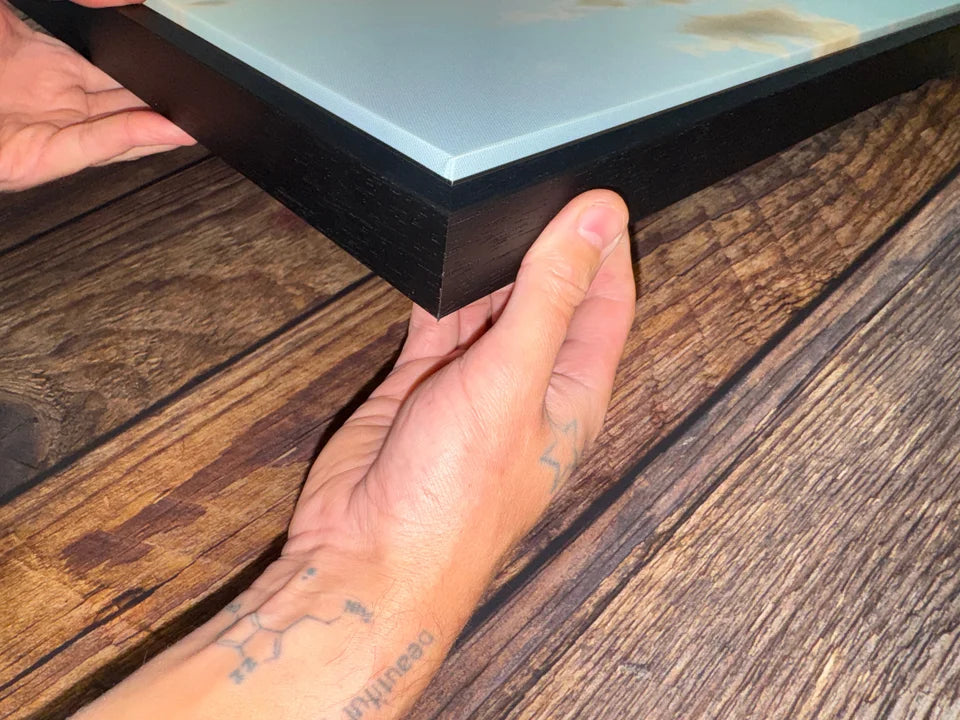
The effect comes from the shadow gap. Our outer frame sits about 5mm away from the canvas, so the picture appears to float inside the wood. Light catches the front edge and falls into that narrow space. Seen from an angle, you notice the depth as well as the photograph.
A normal canvas already has a wooden support inside it. The floating frame is an additional surround. It brings a little more structure and prominence, particularly on a pale wall or above a piece of furniture. There is no glass and no paper mount covering the picture.
You may also see the names tray frame or shadow-gap frame. Framing terms vary: a “box frame” can mean a glazed display box elsewhere. On our site, box frame canvas prints mean this open-front canvas-and-wood finish. For the other canvas profiles, see our Slim, Chunky and floating-frame comparison.
The part you do not usually see
Made by hand, right through to the back.
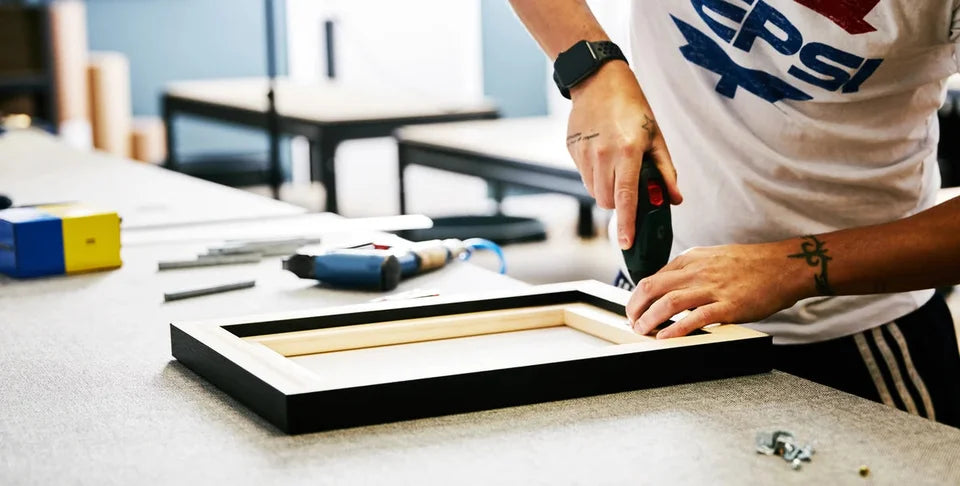
We make these in our own West Yorkshire workshop. Printing, building the canvas support, stretching, fitting and checking all happen here. It means the people handling your photograph also see the finished piece before it is packed.
First, get the photograph right.
We look at the chosen crop and the way the image will sit on the canvas. A face too close to the top, an awkward edge or a small distraction can matter much more once a photograph is enlarged. Where suitable, we prepare the image individually. We want the finished print to feel balanced, while keeping the photograph personal to you.
The frame gives the picture definition; the image preparation still matters. If you are unsure about a file, read how to check a photo for canvas printing, or send us the best version you have.
Then, make the canvas it will sit around.
We print on 230gsm polycotton canvas using our Epson SC-P20000. The canvas is hand-stretched over solid pine. We cut the pine support to size, make the mitred corners and pin them together in the workshop. Folded corners and even tension take attention: they become part of the finished object, even when you mainly notice the picture.
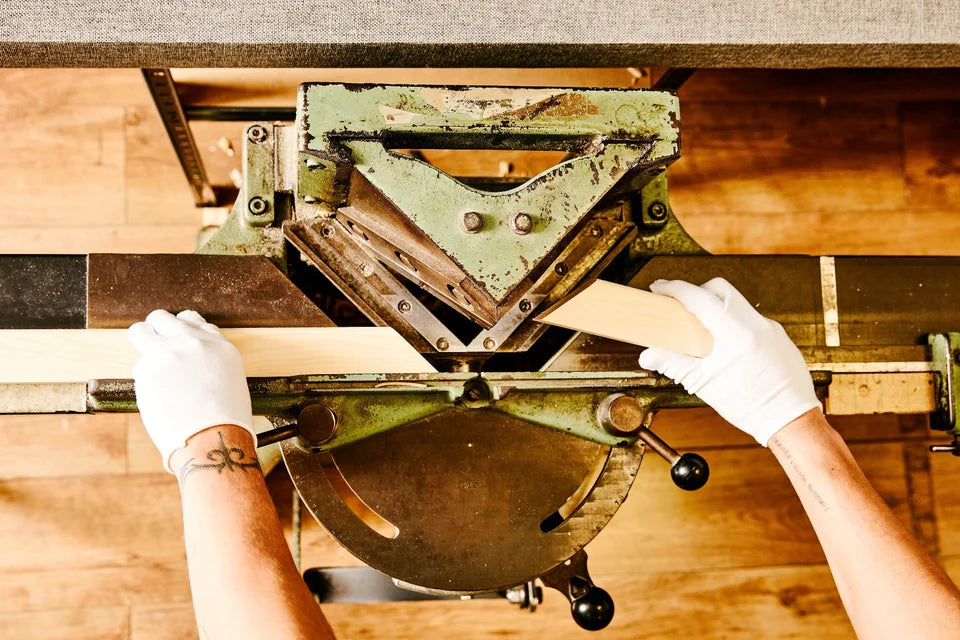

Fit the outer wood frame.
The outer moulding is Ayous wood, a separate component from the pine inside the canvas. Its narrow front edge keeps the outline restrained; the deeper profile gives it substance from the side. We fit the surround around the stretched print, checking the spacing so the canvas sits neatly within it.
The back makes the construction easier to understand. You can see the inner timber supporting the canvas, the outer frame around it and the metal fixings connecting them. The photograph is on stretched fabric, with an open canvas surface at the front.
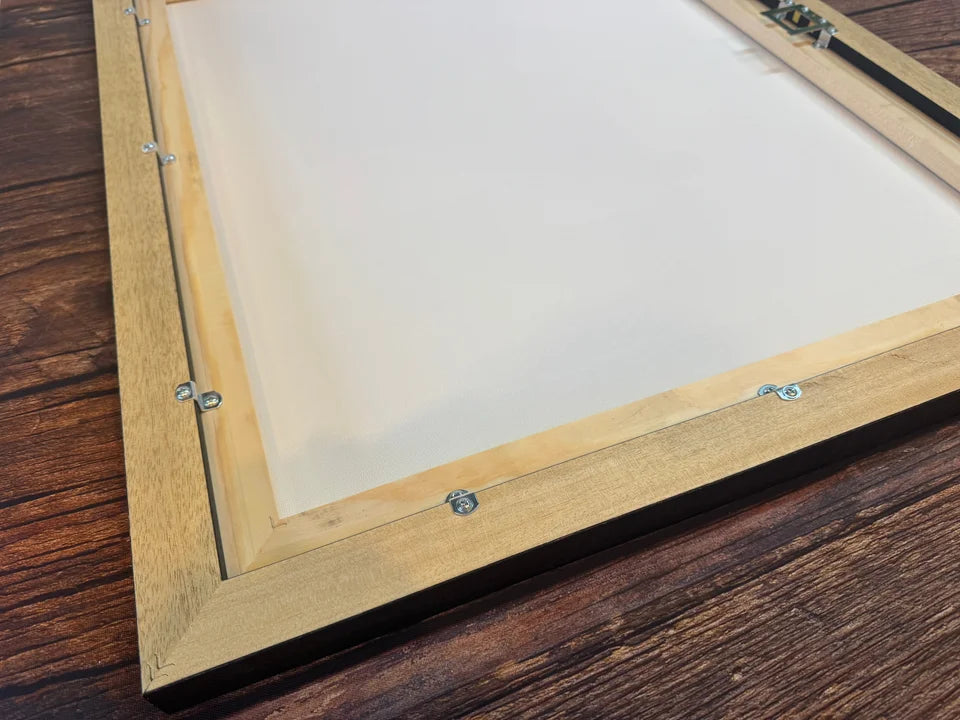
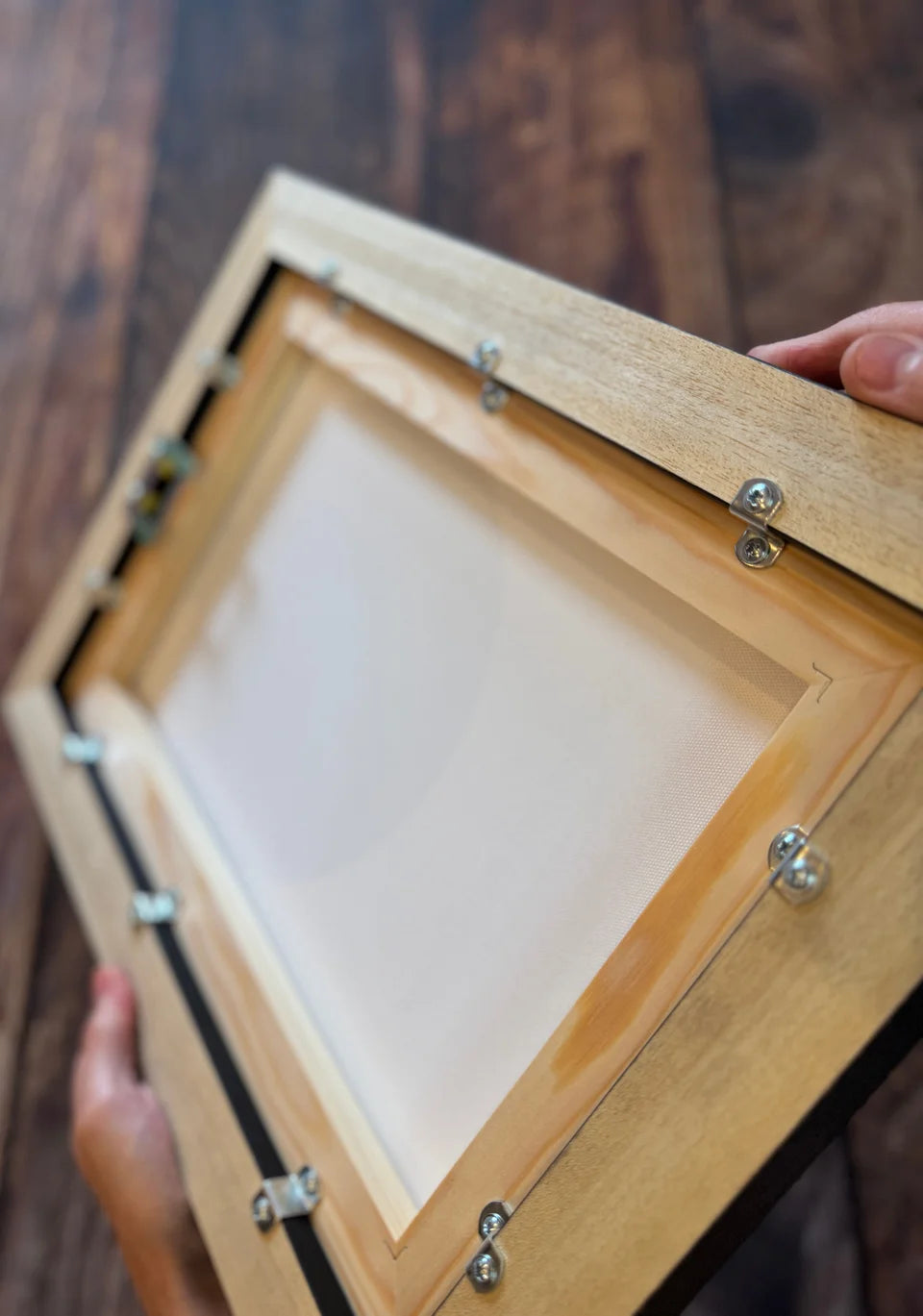
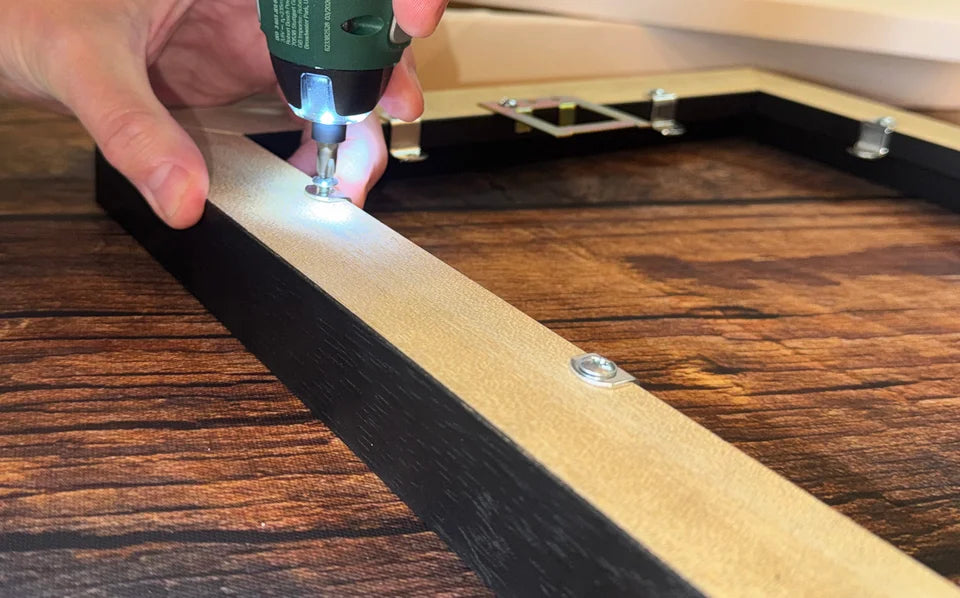
These are our workshop photographs. Look at the join, the fixings and the way the canvas sits inside its surround. Before packing, we check the print and the framed finish together. That care is as relevant to a small present as it is to a large piece for the living room.
One photograph. Four ways to finish it.
Which floating-frame colour should you choose?
Start with the picture, then look around the room. A frame can pick up the dark lines in a photograph, repeat a wood tone in the furniture or sit quietly against the wall. It does not have to match every other frame in the house.
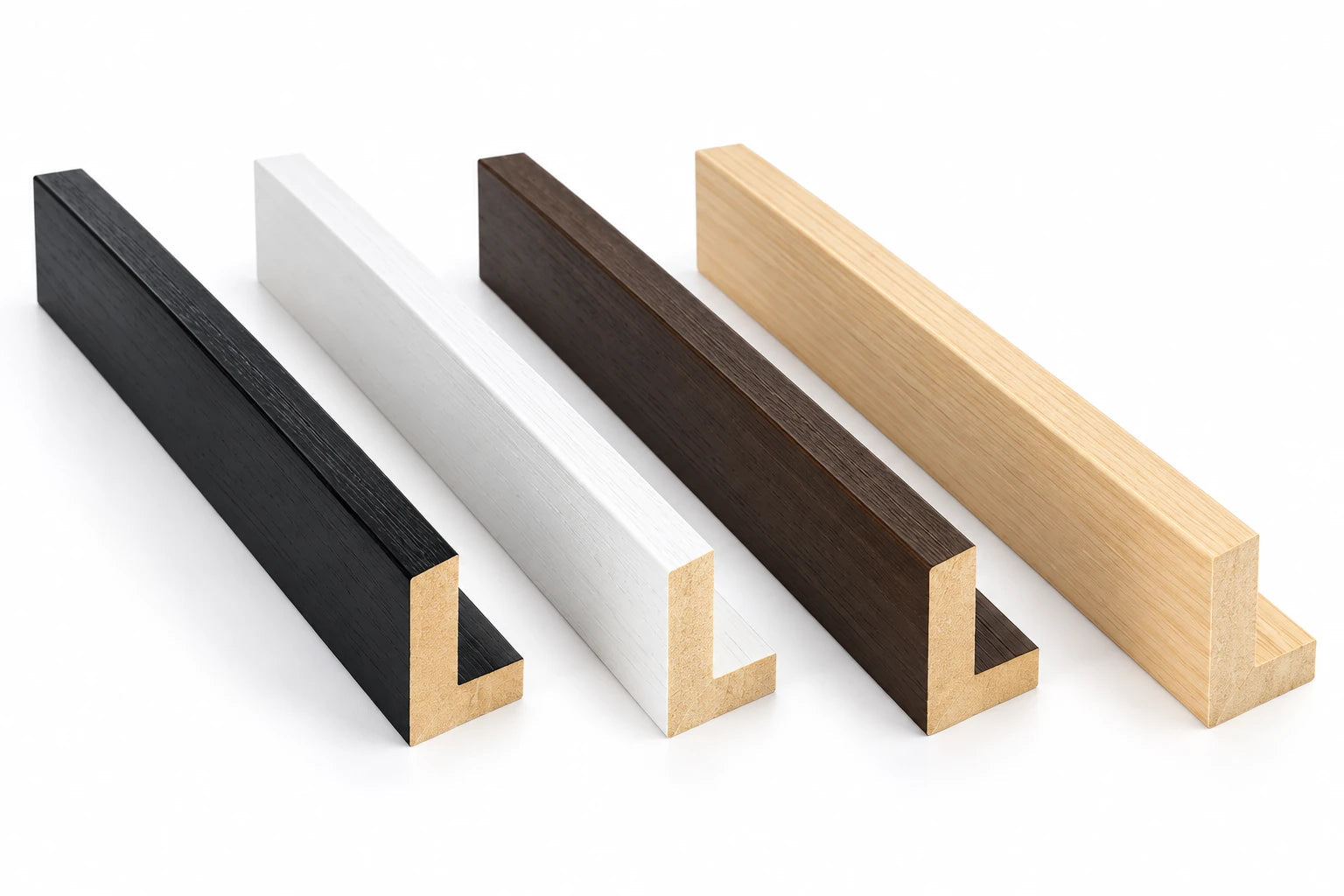
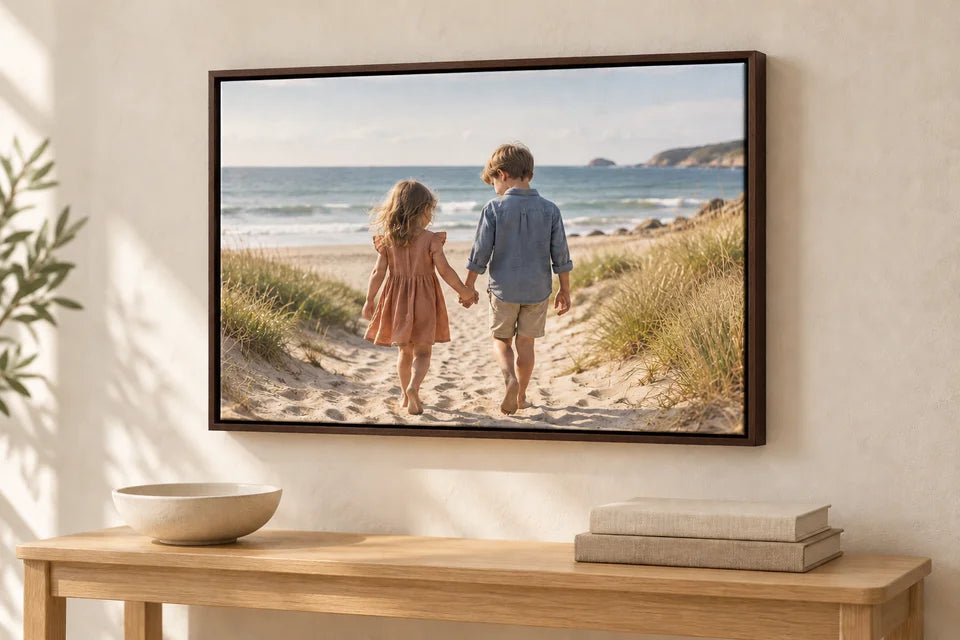
Our four choices are Black, White, Dark wood and Bare wood. Dark wood is the brown finish; Bare wood is natural Ayous. Below, the same beach photograph and setting show how the outline changes its character.
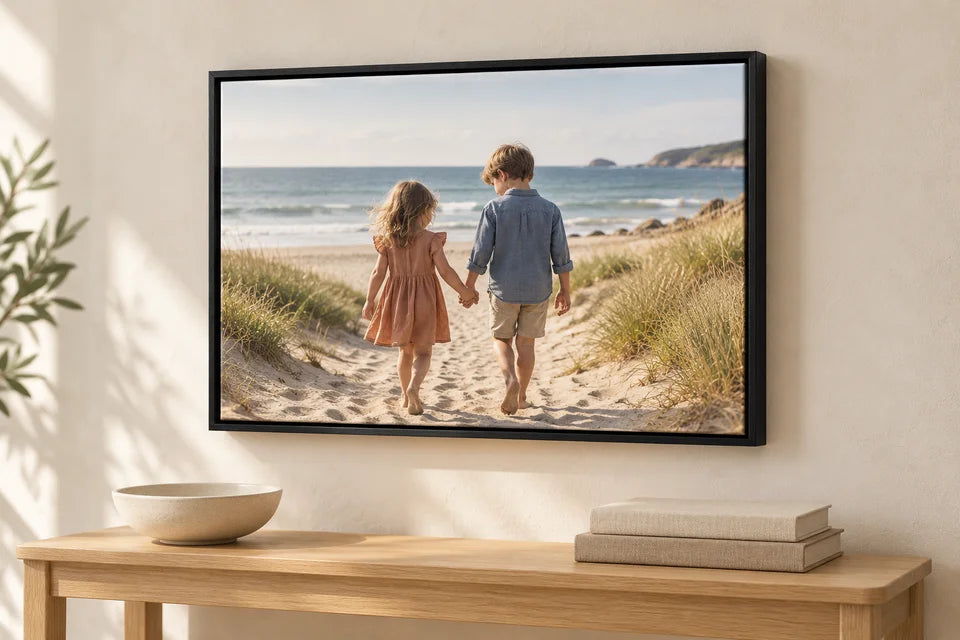
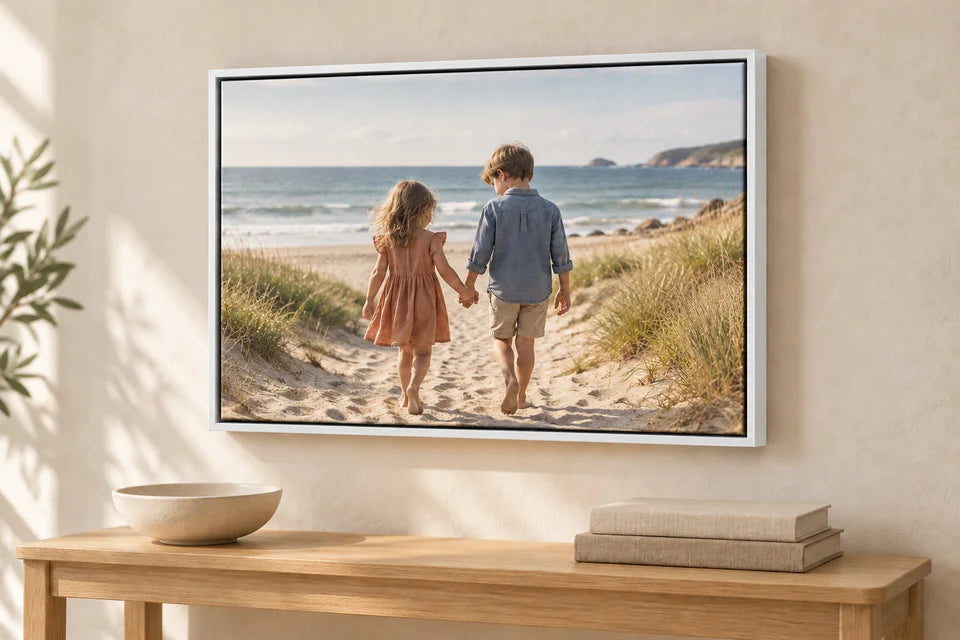
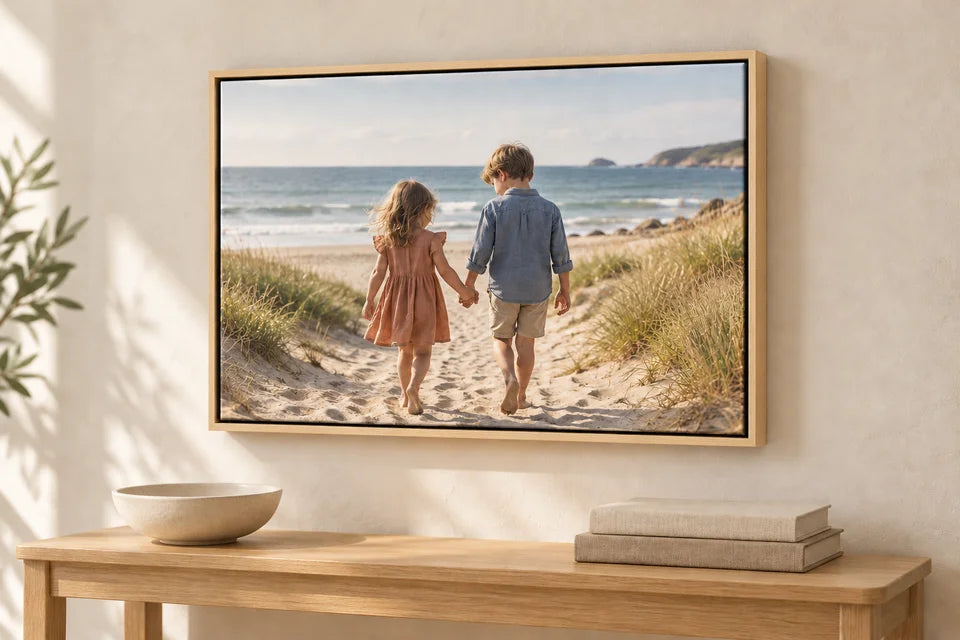
Black is useful when you want definition. It can echo a lamp, a stair rail or the dark parts of the photograph. White makes a lighter transition to a pale wall, especially with bright or airy pictures.
Dark wood brings warmth and sits comfortably beside brown furniture, warm neutrals and deeper colours. Bare wood feels lighter and more relaxed, particularly with natural fabrics, pale timber and coastal photographs.
Try looking at the whole composition rather than matching one exact colour. The beach picture works in every finish; the choice is whether you want the frame to outline it strongly or connect more softly with the room. Screens and lighting affect colour, so use the builder choices and our product photographs when making the final decision.
Keep the feeling of the day
Wedding photographs, in colour or black and white.
A wedding photograph can be the most personal picture in a room. A floating frame gives it a finished edge without adding ornate decoration. Black often works beautifully with the dark tones of a suit and the light of a wedding dress; natural or brown wood can make the same photograph feel warmer.
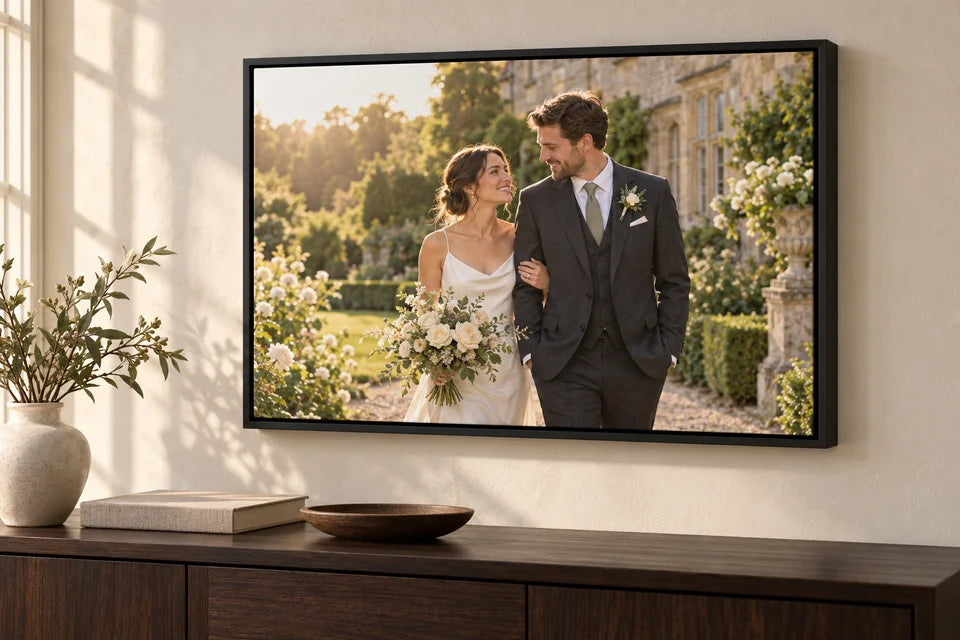
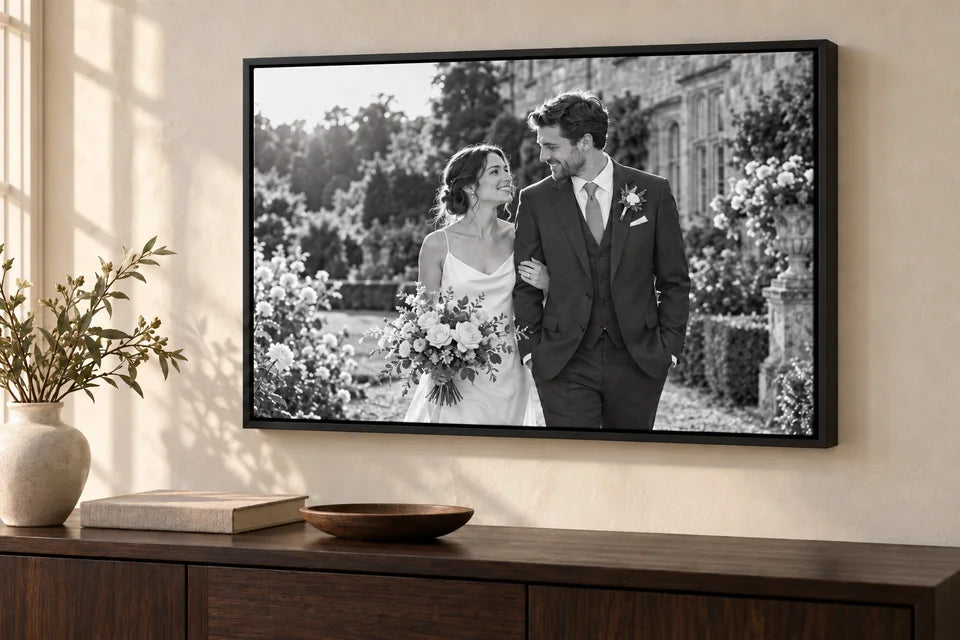
Here the colour version keeps the garden, flowers and late-afternoon warmth. In black and white, your eye settles more quickly on the couple, the expressions and the shape of the light. Neither version is automatically better. Choose the one that brings back the day when you look at it.
A good monochrome print still needs detail in the dress and the darker clothes. Converting to black and white will not rescue a blurred original. You can compare Original and Black & White in our photo creator, then check the crop before ordering. Our wedding canvas guide helps with group photographs and choosing a size.
Let the colour do its work
A frame that makes pop art pop.
Bright artwork benefits from a clear boundary. A black frame can collect all those strong colours into one confident piece. White gives the same image a lighter edge, which can be lovely when the wall and furniture are pale.
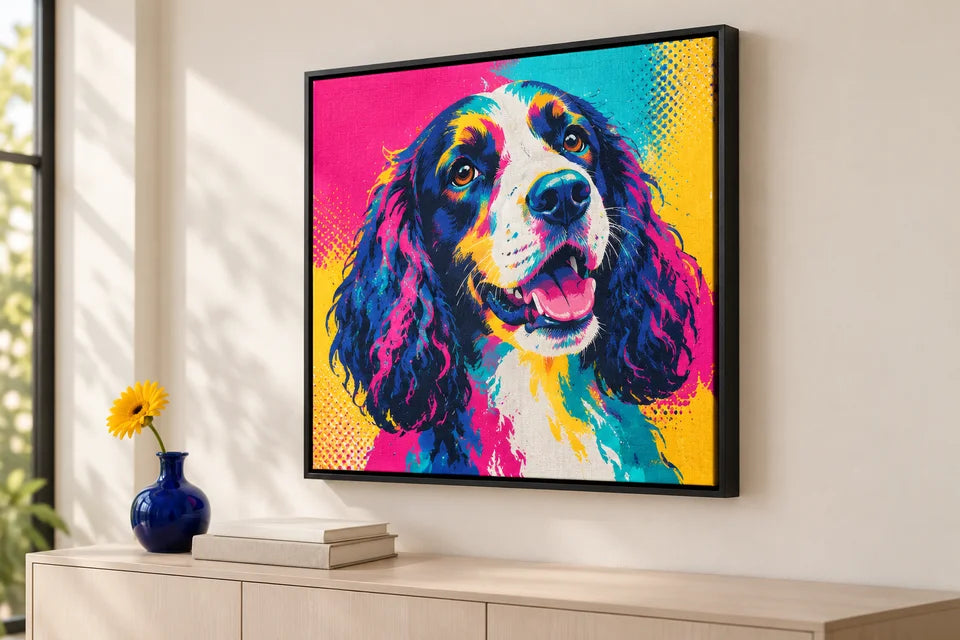
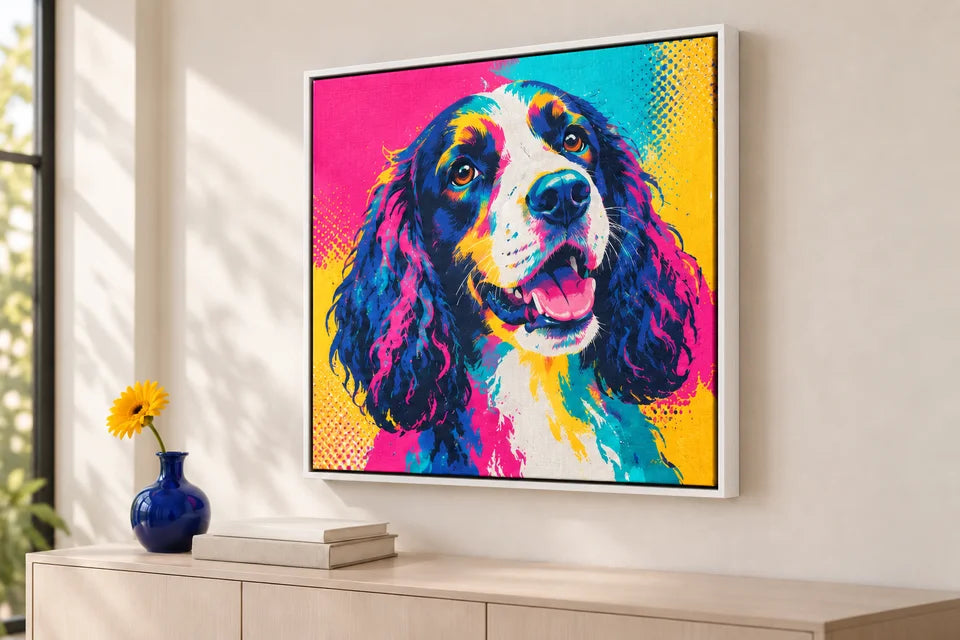
The magenta, turquoise and yellow are doing plenty here. There is no need to repeat every colour around the room. One cushion, a vase or a small detail can make the connection. Leave some clear wall around the frame so the picture has space to be enjoyed.
Use artwork you have created or have permission to print. For a finished digital image, upload the artwork itself, with no photographed room or simulated frame around it. We add the physical floating frame to your canvas.
A place for your picture
From a small hallway print to the centre of the room.
Living room: give one picture the main wall.
The horse portrait at the start of this feature works because it has a clear subject and enough space to hold the seating area together. The black frame connects with the lamp; the quieter sofa and rug leave the photograph in charge. A favourite landscape, family portrait or piece of artwork could do the same job.
Choose the shape that suits the photograph first. Then mark out the intended size on the wall and look from your usual seat. A little extra frame depth will not make an undersized picture fill a large space. Our living-room wall-art guide has more ways to plan the arrangement.
Hallway: make the welcome personal.
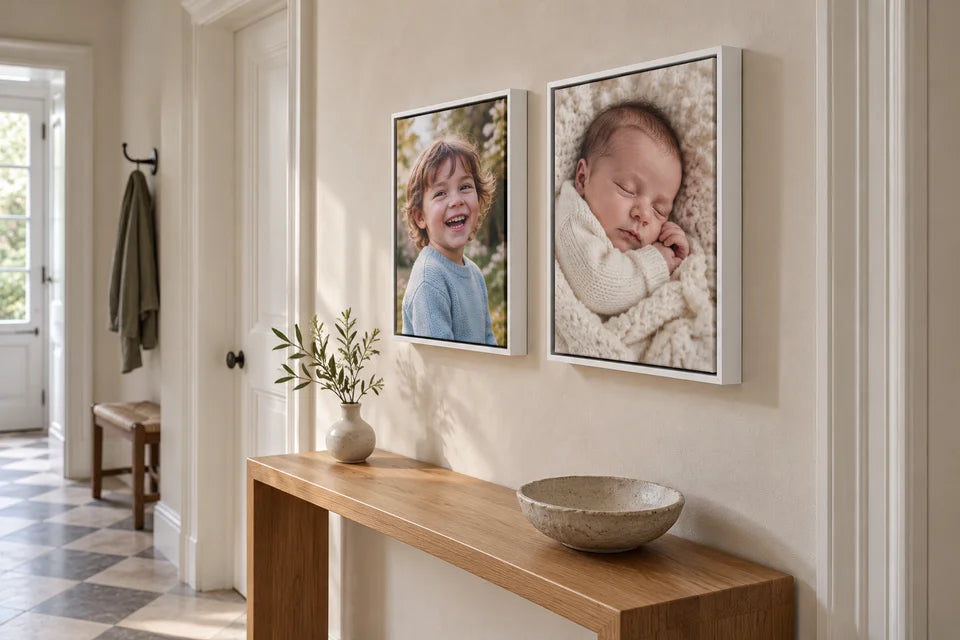
Two smaller photographs can feel just as considered as one large canvas. Matching frame colours give different moments a common edge, whether they are baby photographs, siblings at different ages or pictures from family holidays.
In a hallway, you often see a print from the side before you see it head-on. That is where the wood profile and shadow gap come into their own. Check the projection beside doors and leave comfortable walking space.
Kitchen: a family photograph where life happens.
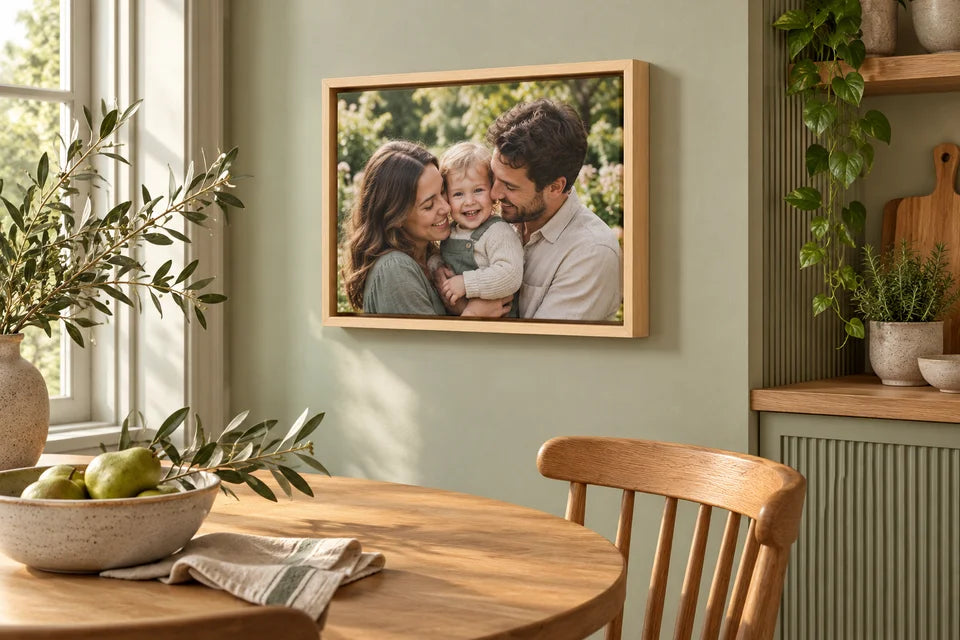
A small framed canvas can bring warmth to a breakfast corner. Bare wood works easily with pale timber and natural textures; white can connect with painted cabinetry. It is a good setting for an everyday family picture rather than saving every photograph for the living room.
Choose a dry dining wall, away from the hob, sink, kettle, splashes and cooking grease. An open canvas is not a wipe-clean kitchen panel. Keep it away from heat and steam, and use a very soft, dry brush for light dusting. Our canvas-care guide explains the finish.
Dining room: bring the wood and colour together.
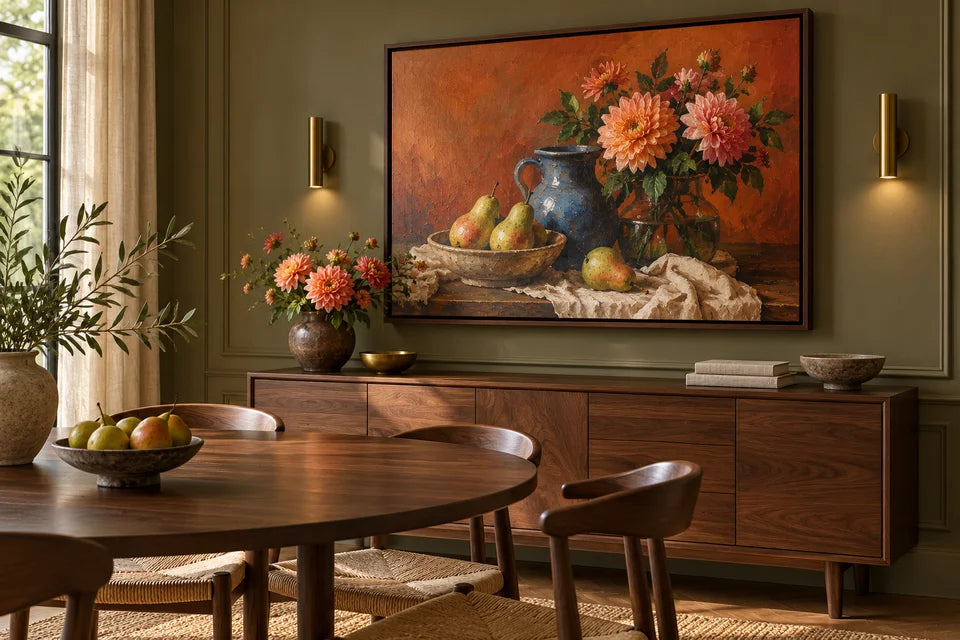
A brown frame can sit beautifully beside a darker sideboard or dining table. Here, the still life adds colour while the wood helps it belong in the room. The same approach works with a travel photograph or a warm family portrait: let the frame make the connection to the furniture.
You can carry the idea into a bedroom or reading corner, too. There is no need for every room to have a dramatic statement. Sometimes a smaller photograph in the right finish is the detail that makes the space feel yours.
Photographs, words and a particular sky
The same finish, with something personal inside.
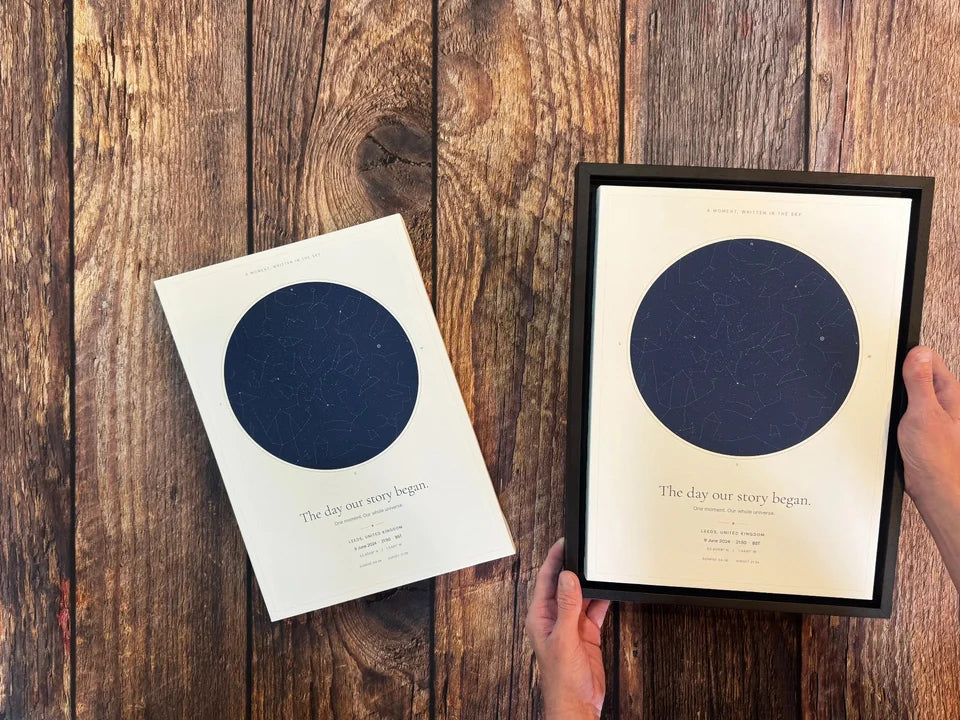
Floating frames also suit the clean shapes of a Star Map or the lettering of Word Art. A dark outline can make a cream background feel crisp; wood can soften the overall effect. Choose the canvas version in the relevant creator and review the frame options offered for your size.
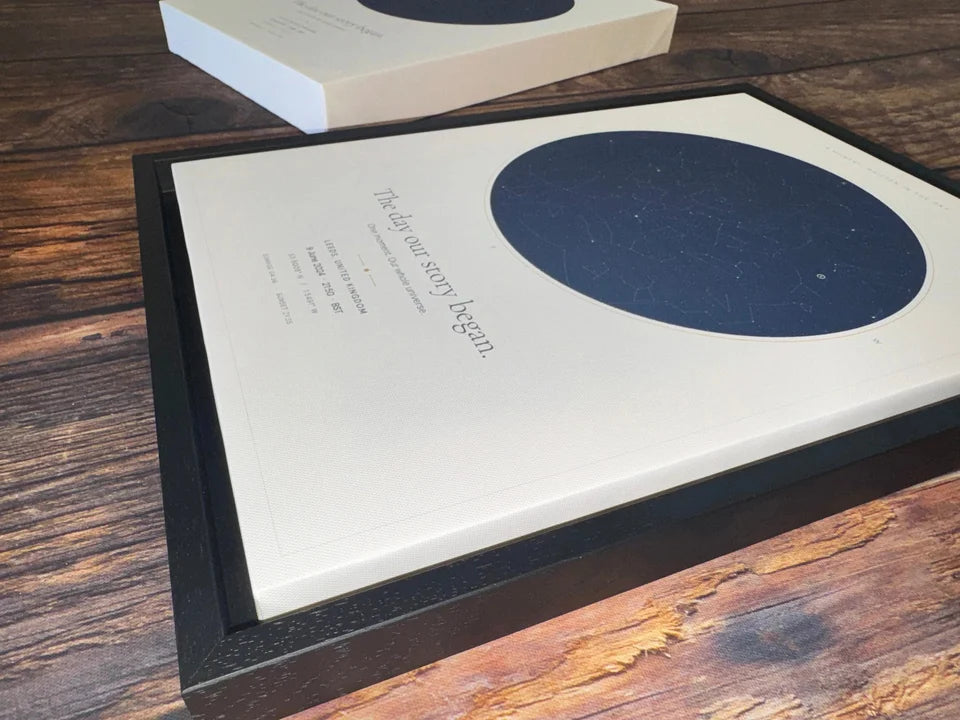
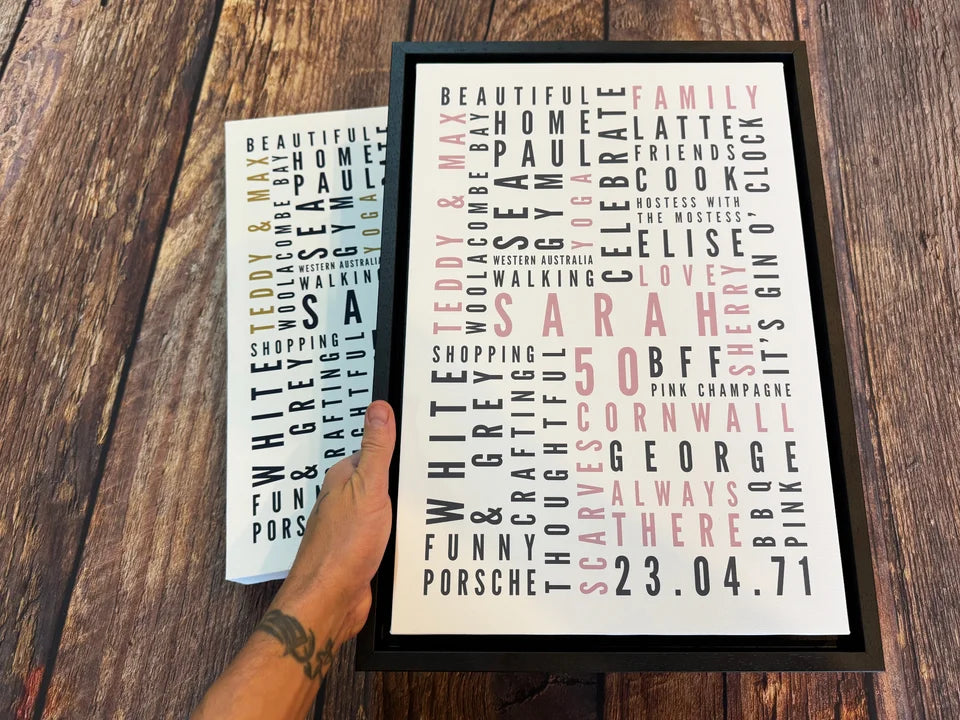
These are actual finished prints from our workshop. Explore personalised Star Maps or Word Art prints to make your own. Their paper poster versions are supplied unframed; the floating wood surround shown here is a canvas finish.
The canvas and the frame
How much does a box frame canvas print cost?
The prices below include the printed canvas and the outer floating frame, with VAT and standard UK delivery. The canvas dimensions describe the picture face, before the surrounding wood and gap. A hanging kit is optional.
| Canvas face | Canvas | Floating frame | Complete |
|---|---|---|---|
| A5 · 21 × 14.8cm | £14.99 | £17.87 | £32.86 |
| A4 · 29.7 × 21cm | £19.99 | £21.97 | £41.96 |
| A3 · 42 × 29.7cm | £27.99 | £27.76 | £55.75 |
| A2 · 59.4 × 42cm | £39.99 | £35.94 | £75.93 |
| 20 × 16″ · 50.8 × 40.64cm | £32.49 | £33.20 | £65.69 |
A hanging kit adds £1.25 for each of these example sizes. Prices checked on 26 October 2026; the creator shows the current total and available extras for your chosen dimensions. The large room scenes are not representations of an A3 print.
An A3 example
£55.75 for the canvas and floating frame.
£57.00 with the optional hanging kit.
Does 3-for-2 include framed canvases?
Qualifying canvas prints count towards the offer, but the floating frames remain chargeable. For three A3 framed canvases, two base prints cost £55.98 and three frames cost £83.28: £139.26 in total, without hanging kits. The cheapest qualifying base print is free; frames, kits and other extras are paid for. The basket calculates the offer.
For a different shape or supported custom size, use the creator and check the full total. See our complete print-price guide for more sizes and options.
Choose the picture. We will make the framed canvas.
- Upload your photograph. Use the best original file you have. Choose the canvas shape and review the front crop, particularly around heads, hands and important details.
- Select your size and Floating frame. Choose Black, White, Dark wood or Bare wood from the available options. Review the recorded edge treatment and the complete price.
- Add a hanging kit if needed. Check the order details and leave any useful image-positioning note for the studio before ordering.
The frame does not cover the front like a conventional picture-frame lip. You still need to choose the right crop for the canvas shape. Our canvas-edge guide explains how the face and sides relate.
Free UK next-working-day delivery*
Order and pay before 2pm UK time, Monday–Friday, with artwork ready for production, for same-day dispatch on our free 24-hour UK service. Most orders arrive on the next working day. This is an expected arrival, not a guarantee.
A Friday order dispatched before the cutoff would normally arrive on Monday; orders after the cutoff or at the weekend move to the next working day for dispatch. Bank holidays, image queries, remote destinations and carrier disruption can affect the timing.
Standard UK delivery is included. Any destination supplement is shown before checkout. Oversized prints add £12 when the longest side is above 140cm, or £30 above 190cm; the higher charge replaces the lower one. Read the delivery schedule and exclusions when planning a gift.
Before you order
Your box frame canvas questions.
Is a floating frame worth the extra cost?
It is worth considering when you want a clearer outline, a wood finish that connects with the room or a little more presence for an important photograph. A stretched canvas without the outer frame is a complete print in its own right. Choose the finish you enjoy looking at.
Is there glass in a box frame canvas?
Our floating-frame canvases have an open front with no glass. You see the canvas surface and texture directly. They are different from glazed box frames used for paper pictures or keepsakes.
Does the frame hide any of the photograph?
The outer frame surrounds the canvas with a gap rather than overlapping its face. Fitting your photograph to the chosen canvas shape can still crop the original image, so review the front preview before ordering.
Do I order the canvas size or the outside frame size?
Choose the dimensions of the canvas face in our creator. The gap and wood add to the finished outside width and height. If it must fit a recess or a tightly measured space, contact us to confirm the overall dimensions before ordering.
Can I buy a floating frame for a canvas I already own?
Our online floating-frame option is an add-on ordered with a new YI2C canvas. If you have an existing canvas or need a frame on its own, ask us before ordering. The width, height and depth all need checking.
Will a phone photograph work?
Often, yes. Use the original file where possible and judge the detail at the intended print size. File size in KB or MB alone does not decide quality. If your favourite is a small file, send it to us for advice; we will consider what is realistic for that picture.
Is the framed canvas supplied assembled?
We fit the canvas into its outer frame in the workshop. A hanging kit is optional; select it in the creator if you need one. Wall fixings must suit your wall and the size and weight of the finished piece. See our canvas-hanging guide.
How do I clean it?
Lift light dust gently with a very soft, dry brush. Keep liquids, furniture polish and glass cleaner away from the canvas. Avoid pressing on the face or pushing into the shadow gap. For a mark or spill, contact us before trying a cleaning product.
Can a framed canvas go in a kitchen or bathroom?
A dry kitchen dining wall can work if it is well away from heat, steam, grease and splashes. Persistent bathroom humidity is a poor setting for an open canvas and timber frame. Choose a more stable, dry room when in doubt.
Can I choose a custom size?
The creator supports custom dimensions within its available limits and shows which finishing options are offered. Check the crop, frame availability and exact total for the dimensions you enter. Ask us if you need help with a particular space.
Found this guide useful?
Add Your Image 2 Canvas as a preferred source on Google.
3 for 2 · Mix and match
Canvas prints.
Quality you can see.
Printed and finished by our family team in West Yorkshire.
From £14.99, including free standard UK delivery.
Create your canvasMix qualifying physical Canvas and Poster prints. Cheapest qualifying base print free; upgrades and extras remain payable. Downloads excluded. Delivery exclusions apply.