01 · Your idea
“I'd like three funny kitchen pictures of my dog that work as a matching set.”
3 FOR 2 ON CANVAS PRINTS · FREE EXPRESS DELIVERY


YOUR IDEA. MADE PERSONAL.
A favourite pet. A dramatic landscape. Something you can picture, but haven't quite found. Start with everyday words, let ChatGPT help develop the idea, and create artwork that feels yours. We'll help you get started—with real examples, detailed prompts and simple ways to refine the result. When you love it, we can print it.
Explore the ideas Already have your artwork? Print it ↗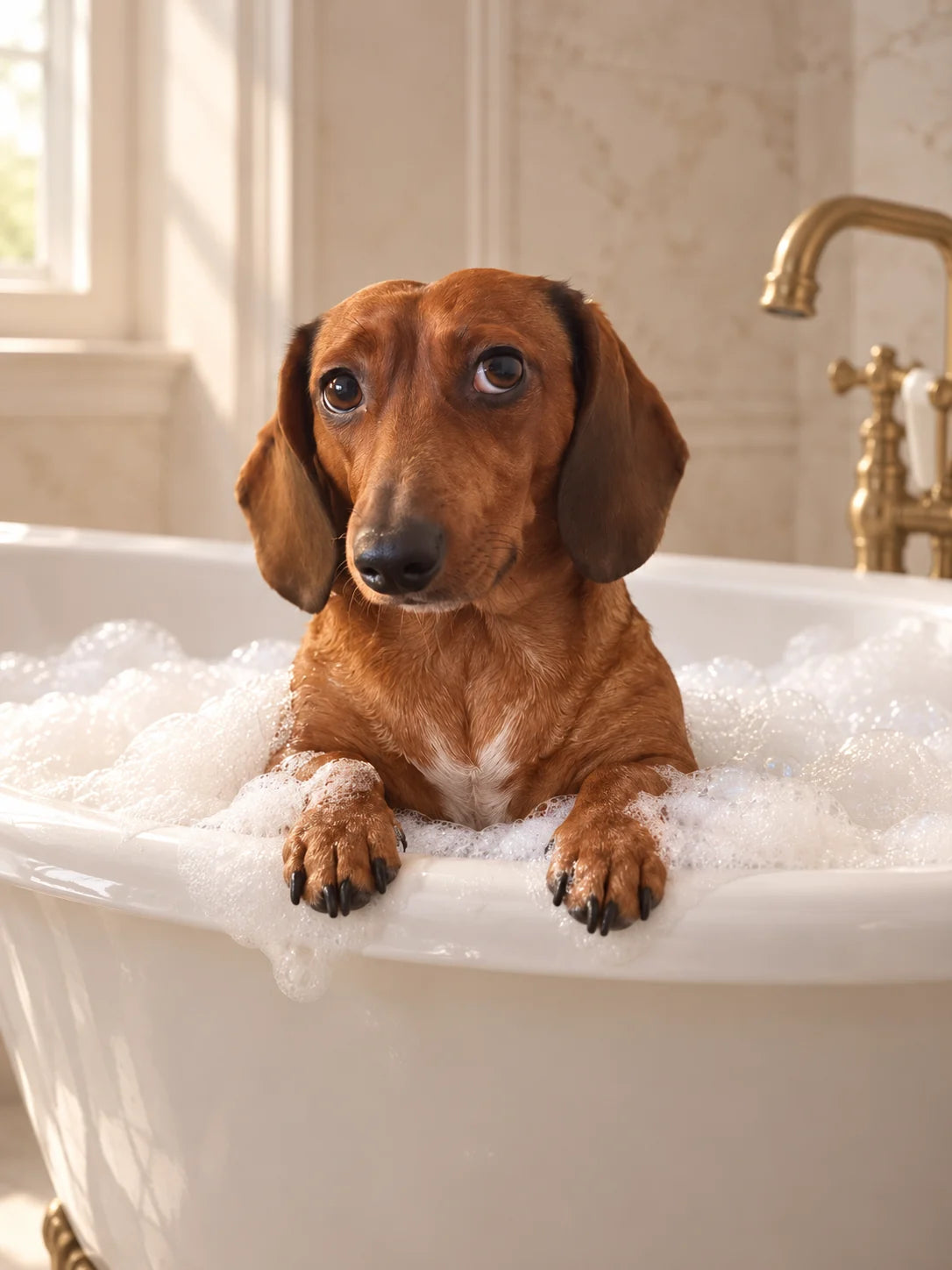
A LITTLE GUIDANCE
You don’t need to arrive with a perfect prompt. Describe what you want in the same words you’d use with a friend. Ask ChatGPT to suggest a few directions, explain what you like, and have it turn your favourite into a detailed image prompt.
“I'd like three funny kitchen pictures of my dog that work as a matching set.”
“Suggest three scenes. Keep them photorealistic, with cream cupboards, pale wood and a little mischief. Then write a detailed prompt for each.”
“I like the biscuit idea. Keep my dog's real face and expression, use soft window light, and leave space around the ears for cropping.”
Replace the bracketed words with your own idea.
Help me develop an idea for artwork for my [room]. I'd like [subject or idea], with a [mood] feeling and [colours]. Suggest three different creative directions. Ask me any useful questions, then write a detailed image prompt for my favourite. If I upload a photograph, explain how to keep the subject recognisable.
Attach files in your ChatGPT conversation and describe their role. Save the actual image file when you are happy with the result. OpenAI’s image help explains the image tools. Access and limits depend on your account.
For practical help, explore Can AI improve a poor-quality photograph for printing? · How to extend a photo with AI for canvas wraps and better crops.
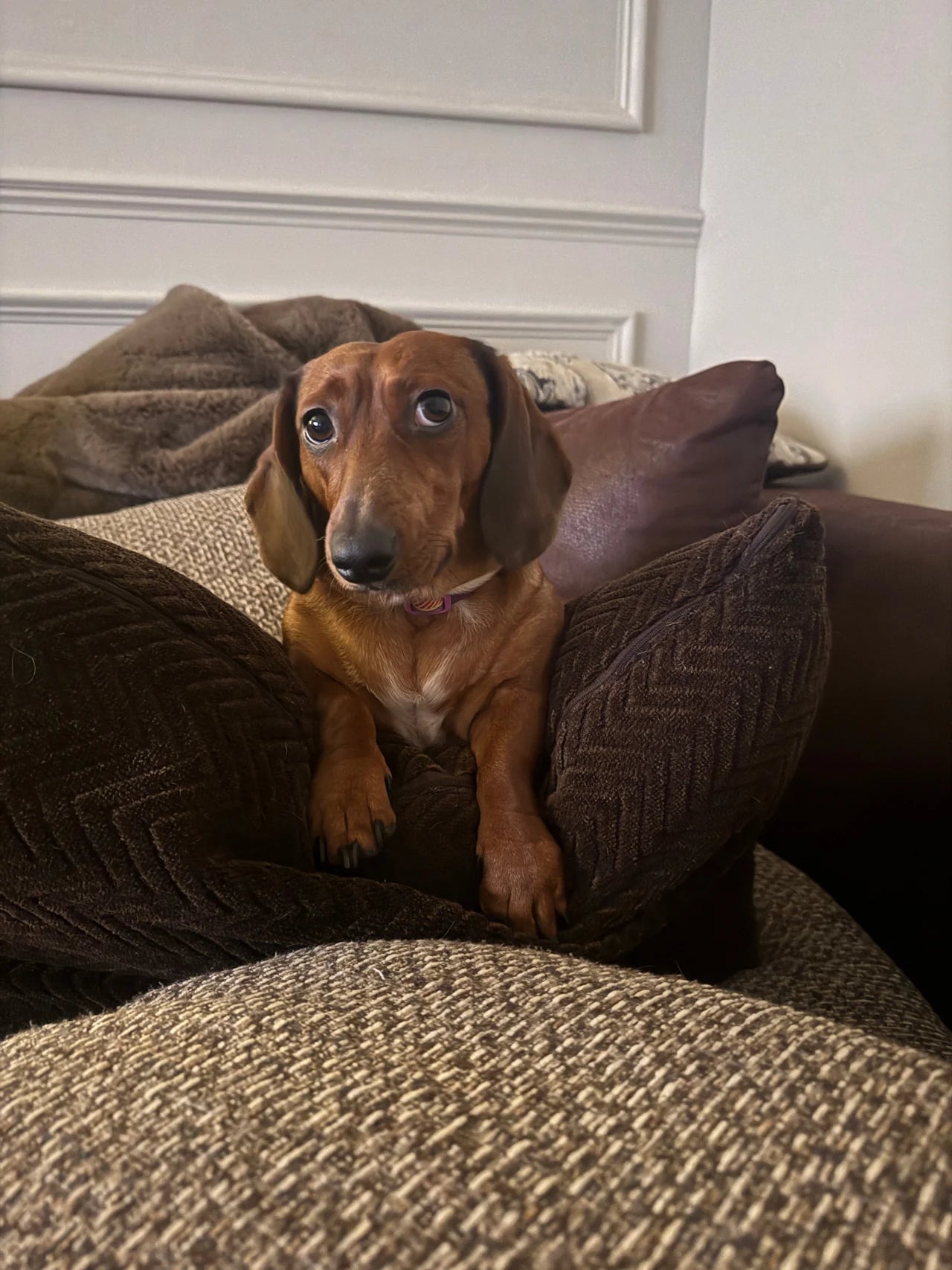
A REAL STARTING POINT
We started with one ordinary dog photograph and developed two coordinated sets. The subject stays familiar while the setting, props and story change. These examples were made in ChatGPT; they aren't photographs of a staged pet shoot.
A clear view of the face, natural light, visible markings and a useful pose give the image tool more to work with. In our bath test, changing the source photograph improved the eyes and result without changing the prompt.
Want portrait styles instead? Explore our five-example AI pet portrait guide.
THREE PICTURES. ONE SET.
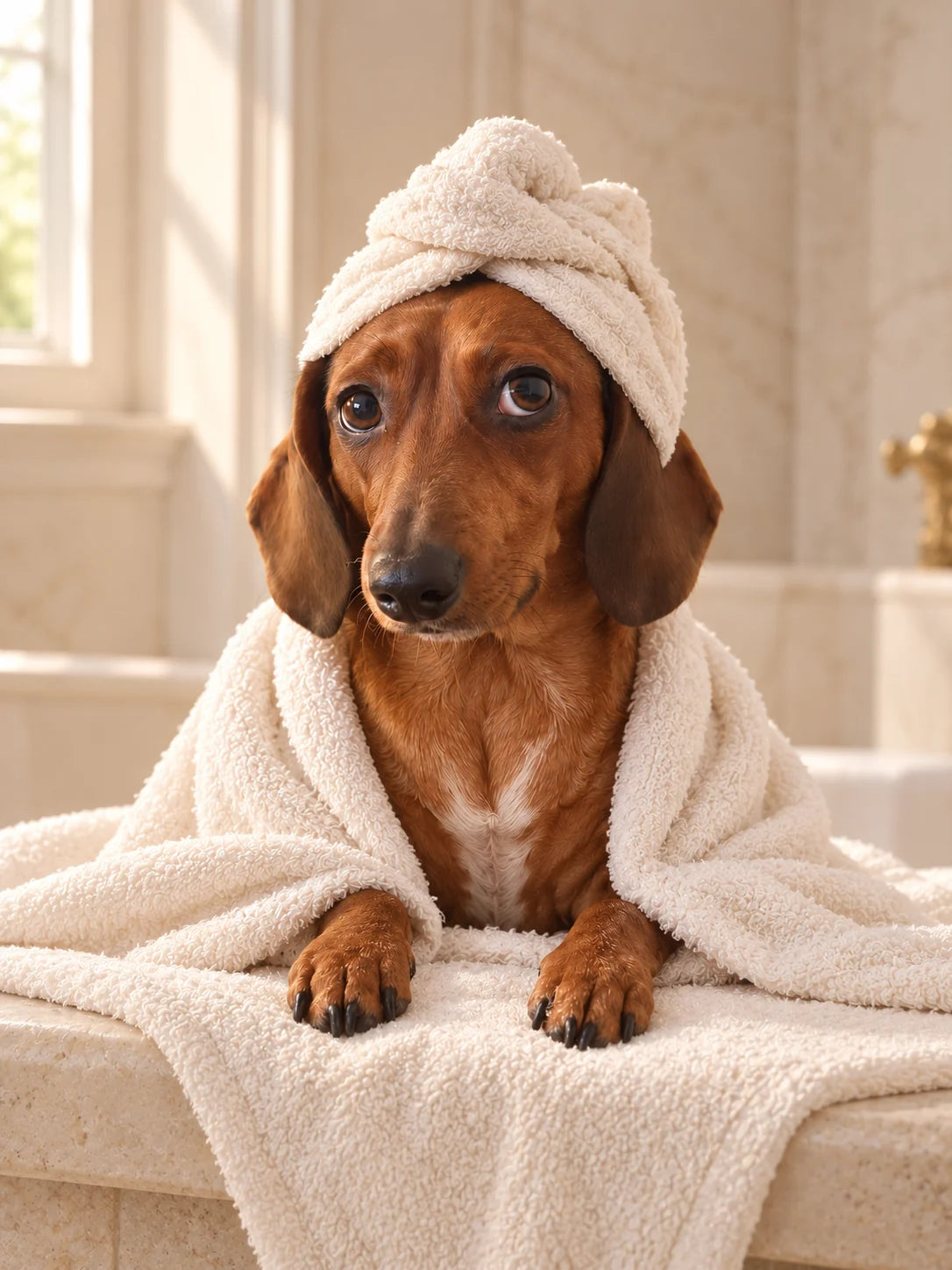
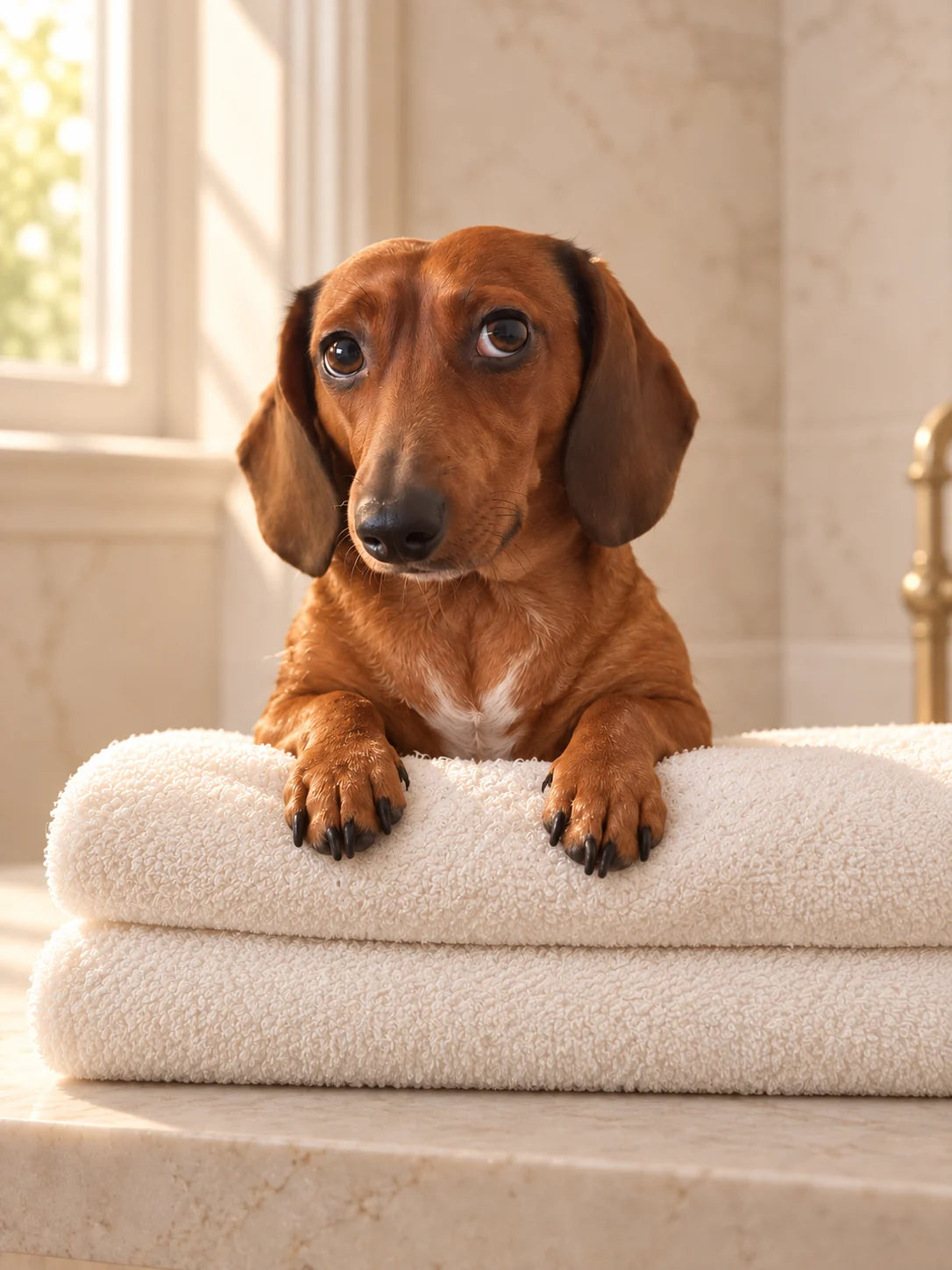
Gentle humour, warm ivory surroundings and matching window light. Three separate pictures with a shared visual language.
A familiar expression does the work. A believable bath, natural paws and soft window light keep the scene affectionate and photographic.
What to attach
Your original pet photograph: identity and anatomy. No generated style reference needed for this first bathroom image.
These are detailed example instructions, not a promise of identical results. Some pack prompts consolidate the original instructions. Adapt the references to your own files.
Changing a field rebuilds the prompt from this example. Then fine-tune the complete text below. A different animal needs its own anatomy check; the shown examples used this dog.
Create a premium, photorealistic bathroom portrait of the exact dog in my attached photograph, relaxing in a bubble bath. The result should feel like a beautifully photographed, gently humorous piece of wall art. Preserve my dog’s identity. Closely follow the original head shape, long muzzle, black nose, floppy ears, brown eyes, reddish-brown coat and distinctive white chest marking. Retain the slight head angle and sideways, mildly suspicious expression. Do not substitute a generic dachshund, shorten the muzzle, enlarge the eyes or add a smile. Preserve natural asymmetry and character. Remove the collar and tag. Replace the original surroundings completely. Scene and pose Place the dog inside a small, realistically proportioned white freestanding bathtub, with its head and upper chest visible above the rim. Two natural front paws rest lightly over the near edge, positioned beneath the shoulders. Keep the short legs and canine anatomy believable: no human arms, hands, fingers or stretched torso. The dog’s lower body is concealed by the bath and foam. Keep both ears hanging naturally outside the bubbles, with the entire face unobstructed. The dog should look comfortably settled, not struggling or startled. Use a modest layer of realistic white foam with varied bubble sizes. Let a few bubbles gather around the paws and inside the rim. No bubble hat, foam beard or bubbles covering the eyes or nose. Keep the face mostly dry, with only subtle dampness on the chest fur. Setting Use a quiet, elegant bathroom with warm ivory walls and subtle pale stone texture. Show only enough surroundings to establish the setting. A small, softly out-of-focus brushed-brass tap may appear to one side, away from the dog’s head. No elaborate room, patterned tiles, toiletries, plants, candles, signs or extra props. Lighting and finish Soft, diffused window light enters from the upper left. Replace the harsh flash reflections from the original photograph with small, natural catchlights while preserving the dog’s actual eye shape, gaze and colour. Keep the reddish coat natural, the white chest neutral and the bath softly white. Preserve fine fur detail, whiskers and realistic nose texture. Use gentle shadows, restrained contrast and subtle depth of field. Keep the entire face and both paws sharp. Avoid an orange cast, artificial eye glow, glossy plastic fur, exaggerated sharpening, cartoon features or a painted finish. Composition Create a portrait 3:4 image, photographed at the dog’s eye level. Frame tightly enough that the dog is the immediate focal point, with the face in the upper-middle area and the curved bath rim across the lower third. Show enough of the bath front to make the scene instantly understandable, without a wide room view. Leave comfortable space around the ears and above the head for later print cropping. Keep the palette consistent: warm ivory, oatmeal, pale stone and the dog’s natural coat colours. The humour should come entirely from the dog’s recognisable expression and the situation. Aim for something affectionate and stylish that someone would genuinely hang in their bathroom. No text, names, logos, watermarks, borders, frames, clothing, rubber ducks, extra animals or human body parts. Return only the finished photograph at the highest available native resolution. Prioritise my dog’s likeness, believable anatomy and convincing photographic detail.Copy uses the complete text above, including your edits. If automatic copying is unavailable, select this text and copy it manually.
Keep the setting and light, change the moment. A softly arranged towel gives the portrait a new story while the face remains the focus.
What to attach
Your original pet photograph: identity. Your approved bubble-bath result: bathroom palette, light, scale and finish only. If they differ, the original pet features take priority.
These are detailed example instructions, not a promise of identical results. Some pack prompts consolidate the original instructions. Adapt the references to your own files.
Changing a field rebuilds the prompt from this example. Then fine-tune the complete text below. A different animal needs its own anatomy check; the shown examples used this dog.
Create a premium photorealistic spa portrait of my dog, matching the attached bubble-bath portrait as another photograph from the same bathroom shoot. REFERENCE ROLES Original dog photo: identity and anatomy. Bubble-bath image: lighting, palette, composition and finish only. Preserve the original dog's real features if references differ. PRESERVE MY PET'S IDENTITY Use the original photograph as the primary identity reference. Preserve the exact head shape, muzzle length and width, nose, eye shape and spacing, eye colour, natural ear shape, coat colour and distinctive markings. Retain the expression, gaze and natural head angle shown in the photograph. Preserve natural asymmetry and individual character. Do not substitute a generic animal, shorten the muzzle, enlarge the eyes, add a smile or invent exaggerated eyebrows. Remove any collar, harness and tags. For this example the subject is the reddish-brown dachshund in the photograph, with a long muzzle, black nose, brown eyes, floppy ears and distinctive white chest marking. If adapting this prompt to another pet, replace this description with that pet's actual features and adjust the anatomy instructions accordingly. SCENE AND POSE Dog naturally seated on a low pale-stone bathroom bench covered with thick ivory cotton towel. Frame head, upper chest and two front paws resting on the towel beneath the shoulders. Keep actual short legs and seated canine proportions, lower body mostly out of frame, no human upright posture. TOWEL STYLING Arrange a small lightweight ivory cotton towel over the crown with a compact loose twist above the forehead. Soft irregular folds and visible terry texture, no towering turban or rigid knot. Fit the towel to the head without changing the head. Both ears hang freely outside it; full face, brows, eyes and muzzle unobstructed. Drape a second towel loosely around the shoulders, open at the chest to reveal the real white marking, natural gravity folds, no robe or sleeves. Mostly towel-dried coat, subtle residual dampness on chest/paws only. SETTING Warm ivory, oatmeal and pale-stone bathroom matching the bath image. Quiet blurred cream stone wall, window suggested at left, optional tiny blurred brass fitting far right away from head. No clutter, toiletries, candles, plants, patterned tiles, cucumbers, masks, sunglasses, ducks or props. The dog's real expression supplies the gentle humour. Match subject scale to bath, towel-covered bench across lower third; keep twist fully inside frame. LIGHTING, DETAIL AND FINISH Use soft natural window light entering from the upper left. Preserve natural coat colours and neutral cream/white surfaces; avoid a strong orange cast. Preserve the real eye colour and gaze with small restrained window catchlights, not large flash discs, glowing pupils or artificial brightening. Render fine fur, individual whiskers, natural nose texture and believable paws and claws. Smooth tonal transitions, restrained contrast, gentle shadows and realistic depth of field. Keep the face and both paws sharp, background softly blurred. No plastic fur, painted finish, excessive HDR, crunchy sharpening or artificial edge blur. COMPOSITION AND OUTPUT Portrait 3:4, photographed at the pet's eye level with natural portrait-lens perspective, no wide-angle distortion. Face in the upper-middle area, paws below, subject the immediate focal point. Leave comfortable space above the head and around the ears for later print cropping. Keep both paws inside the frame. No human arms, hands, fingers, extra limbs, stretched torso, text, logos, watermarks, borders, frames or additional animals. Return only the finished photograph at the highest available native resolution. Prioritise likeness and believable anatomy.Copy uses the complete text above, including your edits. If automatic copying is unavailable, select this text and copy it manually.
The simplest scenes can work beautifully. A small stack of towels, a recognisable face and a quiet background complete the set.
What to attach
Your original pet photograph: identity. Your approved bubble-bath result: palette, lighting, scale and finish only.
These are detailed example instructions, not a promise of identical results. Some pack prompts consolidate the original instructions. Adapt the references to your own files.
Changing a field rebuilds the prompt from this example. Then fine-tune the complete text below. A different animal needs its own anatomy check; the shown examples used this dog.
Create a premium photorealistic portrait of my dog peeking over two neatly folded ivory towels in an elegant bathroom, a coordinated companion to the bubble-bath and spa portraits. REFERENCE ROLES Original dog photo is identity reference; bubble-bath image is lighting, palette, subject scale and finish reference only. Original features take priority. PRESERVE MY PET'S IDENTITY Use the original photograph as the primary identity reference. Preserve the exact head shape, muzzle length and width, nose, eye shape and spacing, eye colour, natural ear shape, coat colour and distinctive markings. Retain the expression, gaze and natural head angle shown in the photograph. Preserve natural asymmetry and individual character. Do not substitute a generic animal, shorten the muzzle, enlarge the eyes, add a smile or invent exaggerated eyebrows. Remove any collar, harness and tags. For this example the subject is the reddish-brown dachshund in the photograph, with a long muzzle, black nose, brown eyes, floppy ears and distinctive white chest marking. If adapting this prompt to another pet, replace this description with that pet's actual features and adjust the anatomy instructions accordingly. SCENE AND POSE Dog comfortably supported on broad low pale-stone bench behind TWO folded towels sharing the same supporting surface. Head and upper chest above towels, two natural short front paws lightly over near edge of top towel beneath shoulders. Stack low enough for actual leg reach. Lower body hidden behind stack; no stretched torso or legs. Both ears free, chin above towel, face unobstructed, original expression toward camera. TOWELS Two thick ivory cotton towels with softly rounded natural folds, small compression beneath paws, matte terry loops and weave, subtle shadows between layers. Modest stack across lower third, not inflated pillows, rigid folds or a tall pile. Narrow stone bench below. NO towel on head or shoulders, baskets, shelves or extra linen. SETTING Match warm ivory/oatmeal/pale-stone bathroom, cream softly textured blurred wall, same soft window left, optional blurred brass far right away face. No clutter, tiles, plants, candles, toiletries, toilet or newspaper. Close framing matching bath scale, towels subordinate to face. Affectionate understated humour from expression and paws. LIGHTING, DETAIL AND FINISH Use soft natural window light entering from the upper left. Preserve natural coat colours and neutral cream/white surfaces; avoid a strong orange cast. Preserve the real eye colour and gaze with small restrained window catchlights, not large flash discs, glowing pupils or artificial brightening. Render fine fur, individual whiskers, natural nose texture and believable paws and claws. Smooth tonal transitions, restrained contrast, gentle shadows and realistic depth of field. Keep the face and both paws sharp, background softly blurred. No plastic fur, painted finish, excessive HDR, crunchy sharpening or artificial edge blur. COMPOSITION AND OUTPUT Portrait 3:4, photographed at the pet's eye level with natural portrait-lens perspective, no wide-angle distortion. Face in the upper-middle area, paws below, subject the immediate focal point. Leave comfortable space above the head and around the ears for later print cropping. Keep both paws inside the frame. No human arms, hands, fingers, extra limbs, stretched torso, text, logos, watermarks, borders, frames or additional animals. Return only the finished photograph at the highest available native resolution. Prioritise likeness and believable anatomy.Copy uses the complete text above, including your edits. If automatic copying is unavailable, select this text and copy it manually.
Generation can introduce variations despite detailed instructions. Review the result: these examples do not demonstrate perfect compliance with every line of a prompt.
THREE PICTURES. ONE SET.
Cream cupboards, pale oak, muted sage and natural daylight. A new setting, with the same familiar face at the centre.
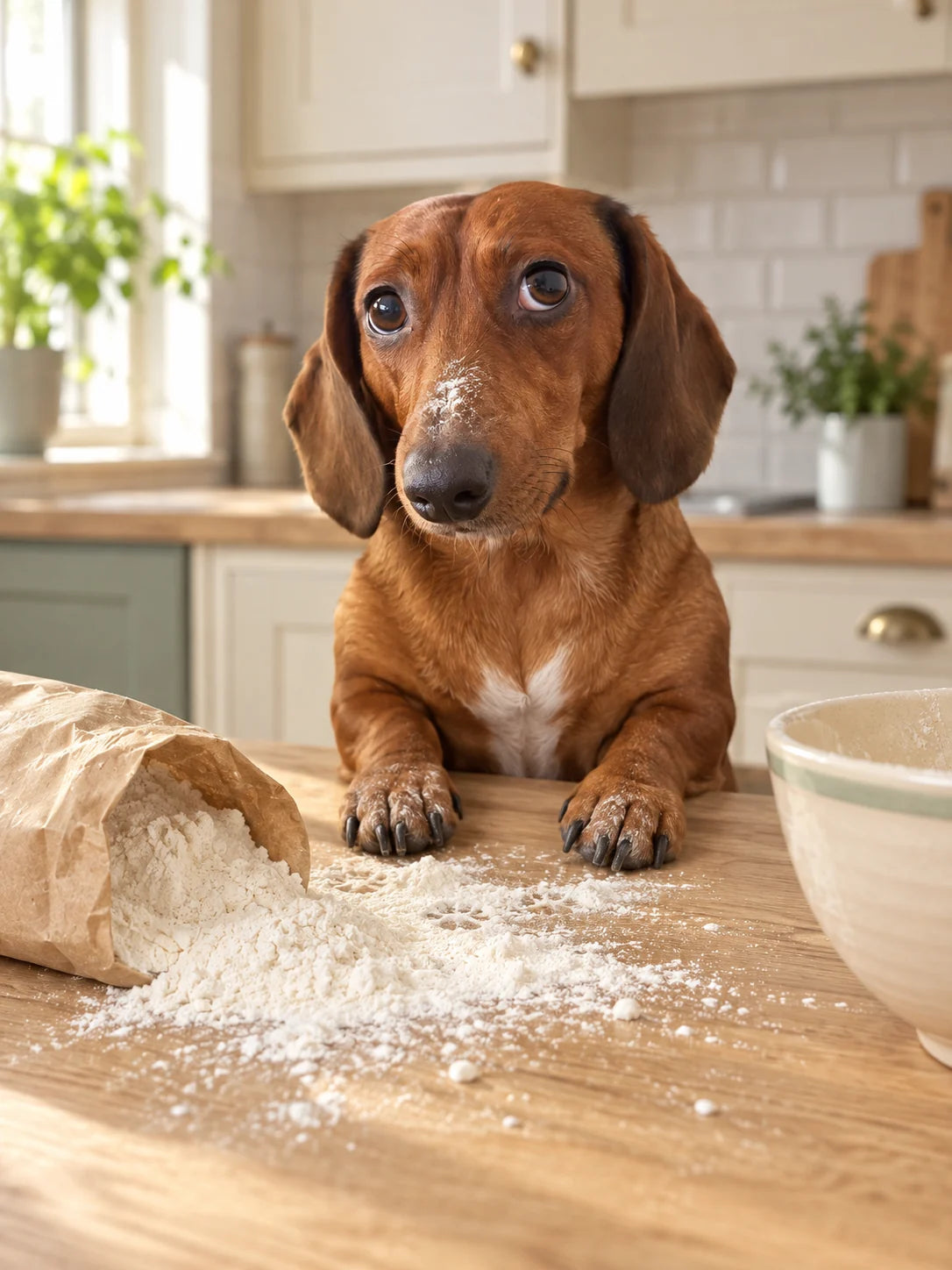
A tiny dusting on the muzzle and a tipped flour bag create the joke. We asked for natural proportions and a modest mess, rather than a dog dressed as a person.
What to attach
Your original pet photograph: identity and anatomy. Start a fresh kitchen; no bathroom style reference is needed.
These are detailed example instructions, not a promise of identical results. Some pack prompts consolidate the original instructions. Adapt the references to your own files.
Changing a field rebuilds the prompt from this example. Then fine-tune the complete text below. A different animal needs its own anatomy check; the shown examples used this dog.
Create a premium photorealistic kitchen portrait of my dog caught beside a small baking mishap, first of a coordinated trio. The charm comes from a little flour and the pet's actual expression. REFERENCE ROLE Original dog photograph is primary identity and anatomy reference. No bathroom style reference is required; create the fresh kitchen described below. PRESERVE MY PET'S IDENTITY Use the original photograph as the primary identity reference. Preserve the exact head shape, muzzle length and width, nose, eye shape and spacing, eye colour, natural ear shape, coat colour and distinctive markings. Retain the expression, gaze and natural head angle shown in the photograph. Preserve natural asymmetry and individual character. Do not substitute a generic animal, shorten the muzzle, enlarge the eyes, add a smile or invent exaggerated eyebrows. Remove any collar, harness and tags. For this example the subject is the reddish-brown dachshund in the photograph, with a long muzzle, black nose, brown eyes, floppy ears and distinctive white chest marking. If adapting this prompt to another pet, replace this description with that pet's actual features and adjust the anatomy instructions accordingly. SCENE AND POSE Dog naturally seated on broad supporting bench behind low pale-oak worktable, chest comfortably table height without stretching short legs or torso. Head upper chest and two paws near table edge beneath shoulders. Support and lower body concealed. No human posture, paws holding utensils, clothing, chef hat or apron. THE MISHAP Small unbranded creased kraft flour bag on its side to one side, opening toward modest irregular spill. Matte fine powder, tiny clumps, subtle contact shadows and a couple of paw impressions. Tiny uneven dusting on TOP of muzzle away from eyes; nose nostrils and mouth clear, no white mask. Pale ceramic mixing bowl farther opposite side partly framed and secondary; no other equipment. Original questioning expression toward camera, no invented guilty brows. No airborne flour cloud. KITCHEN Inviting bright cream cupboards, pale oak worktable, muted sage accents, softly blurred pale tiled splashback. Consistent cream/oak/sage/kraft/natural fur palette. Soft upper-left daylight, fresh not dim, subtle shadows. No bold patterns, colourful appliances, busy shelves, readable brands or signs. Matte restrained wood grain, softly glazed bowl, creased partly collapsed paper bag. Bag and bowl balance loosely, not exact symmetry, props below face away ears. LIGHTING, DETAIL AND FINISH Use soft natural window light entering from the upper left. Preserve natural coat colours and neutral cream/white surfaces; avoid a strong orange cast. Preserve the real eye colour and gaze with small restrained window catchlights, not large flash discs, glowing pupils or artificial brightening. Render fine fur, individual whiskers, natural nose texture and believable paws and claws. Smooth tonal transitions, restrained contrast, gentle shadows and realistic depth of field. Keep the face and both paws sharp, background softly blurred. No plastic fur, painted finish, excessive HDR, crunchy sharpening or artificial edge blur. COMPOSITION AND OUTPUT Portrait 3:4, photographed at the pet's eye level with natural portrait-lens perspective, no wide-angle distortion. Face in the upper-middle area, paws below, subject the immediate focal point. Leave comfortable space above the head and around the ears for later print cropping. Keep both paws inside the frame. No human arms, hands, fingers, extra limbs, stretched torso, text, logos, watermarks, borders, frames or additional animals. Return only the finished photograph at the highest available native resolution. Prioritise likeness and believable anatomy.Copy uses the complete text above, including your edits. If automatic copying is unavailable, select this text and copy it manually.
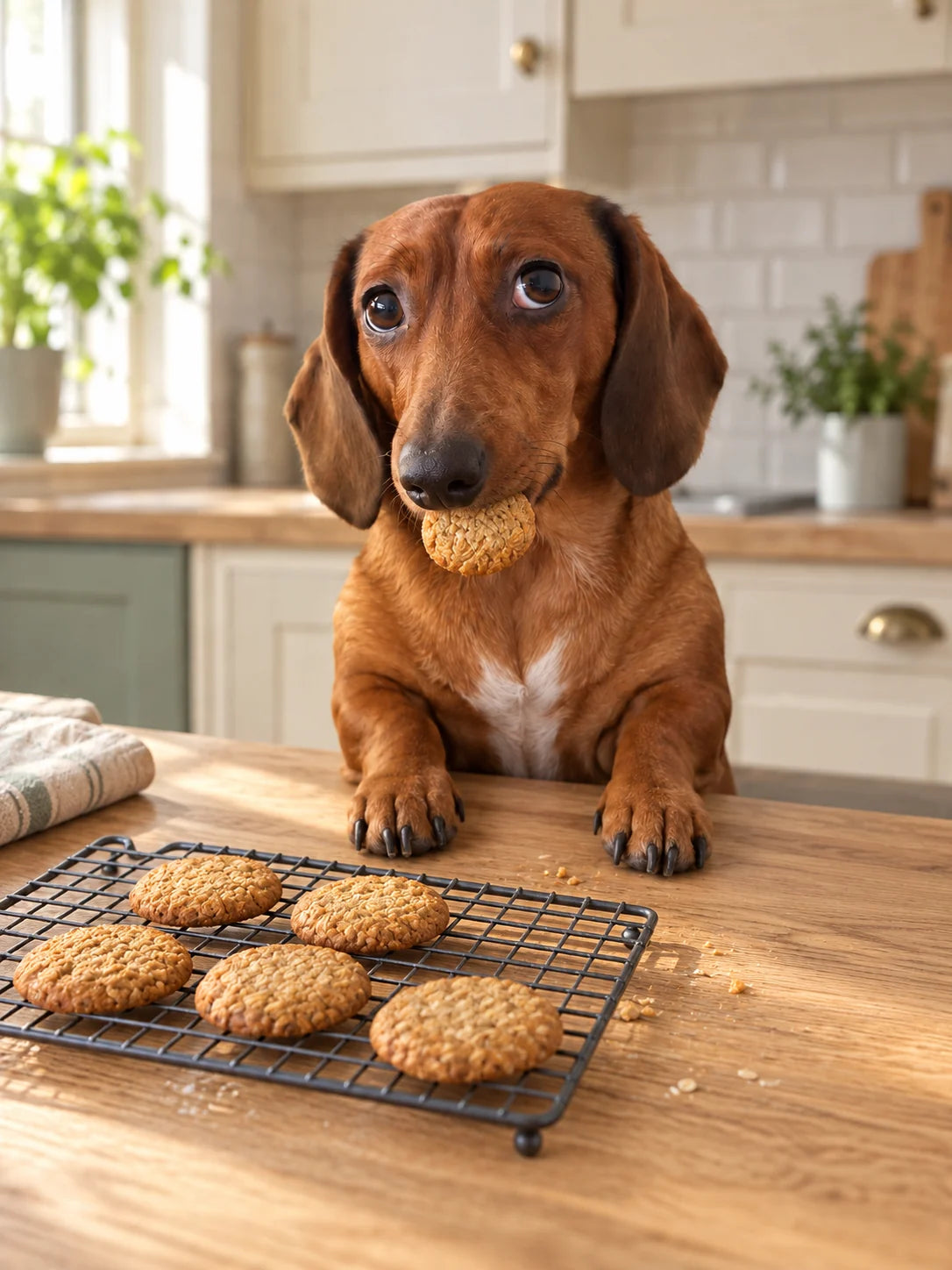
Give the picture a little story. A missing biscuit and a questioning look can say more than a busy scene.
What to attach
Your original pet photograph: identity and anatomy. Your approved flour result: kitchen, palette, light, scale and framing only.
These are detailed example instructions, not a promise of identical results. Some pack prompts consolidate the original instructions. Adapt the references to your own files.
Changing a field rebuilds the prompt from this example. Then fine-tune the complete text below. A different animal needs its own anatomy check; the shown examples used this dog.
Create a premium photorealistic kitchen portrait of my dog caught stealing a biscuit, second of a matching trio. REFERENCE ROLES Original dog photo: exact identity and anatomy. Flour-mishap image: same cream/oak/sage kitchen, upper-left daylight, finish, scale and framing. Original features take priority. Coat, paws and muzzle clean, no flour in this scene. PRESERVE MY PET'S IDENTITY Use the original photograph as the primary identity reference. Preserve the exact head shape, muzzle length and width, nose, eye shape and spacing, eye colour, natural ear shape, coat colour and distinctive markings. Retain the expression, gaze and natural head angle shown in the photograph. Preserve natural asymmetry and individual character. Do not substitute a generic animal, shorten the muzzle, enlarge the eyes, add a smile or invent exaggerated eyebrows. Remove any collar, harness and tags. For this example the subject is the reddish-brown dachshund in the photograph, with a long muzzle, black nose, brown eyes, floppy ears and distinctive white chest marking. If adapting this prompt to another pet, replace this description with that pet's actual features and adjust the anatomy instructions accordingly. SCENE AND POSE Dog naturally seated on concealed broad bench behind same low pale-oak worktable, chest comfortably table height, actual short legs and canine proportions, two paws near edge under shoulders. No human posture or paws gripping food. BISCUIT STORY Modest dark-metal cooling rack slightly to one side on table. FIVE small plain golden oat biscuits in two loosely spaced rows with clear empty sixth position. Dog gently holds sixth SMALL biscuit between front teeth, part protruding below lips; mouth opens only enough to hold naturally. Preserve muzzle shape, no widened jaw human smile exaggerated teeth or distorted lips; nose unobstructed, biscuit physically supported not floating or fused into fur. A few tiny crumbs below. Matte baked oat texture irregular edges. No chocolate icing letters decorative shapes. Original questioning look at camera, joke from missing biscuit. MATCHING SETTING Same cream cupboards pale oak muted sage accents pale tile and understated background as flour image. Match light brightness warmth direction dog scale. No new prominent props or colours. Rack coherent straight wires perspective contact shadows, matte wood. Face remains dominant, rack and empty position visible below. No hats, apron, clothes or utensils held by paws. LIGHTING, DETAIL AND FINISH Use soft natural window light entering from the upper left. Preserve natural coat colours and neutral cream/white surfaces; avoid a strong orange cast. Preserve the real eye colour and gaze with small restrained window catchlights, not large flash discs, glowing pupils or artificial brightening. Render fine fur, individual whiskers, natural nose texture and believable paws and claws. Smooth tonal transitions, restrained contrast, gentle shadows and realistic depth of field. Keep the face and both paws sharp, background softly blurred. No plastic fur, painted finish, excessive HDR, crunchy sharpening or artificial edge blur. COMPOSITION AND OUTPUT Portrait 3:4, photographed at the pet's eye level with natural portrait-lens perspective, no wide-angle distortion. Face in the upper-middle area, paws below, subject the immediate focal point. Leave comfortable space above the head and around the ears for later print cropping. Keep both paws inside the frame. No human arms, hands, fingers, extra limbs, stretched torso, text, logos, watermarks, borders, frames or additional animals. Return only the finished photograph at the highest available native resolution. Prioritise likeness and believable anatomy.Copy uses the complete text above, including your edits. If automatic copying is unavailable, select this text and copy it manually.
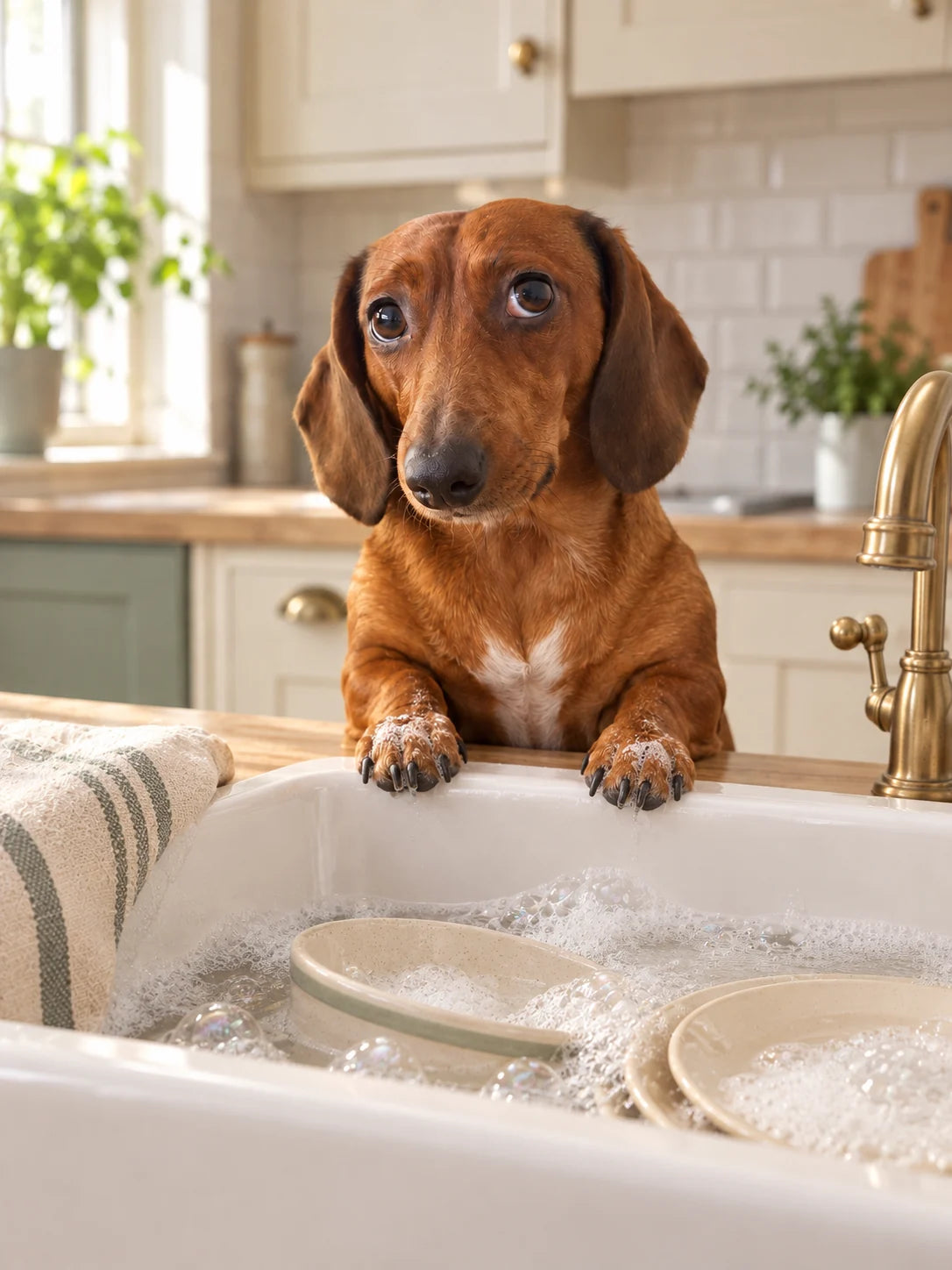
Change the activity, keep the visual language. Matching light, colours and subject size help separate images feel like a set.
What to attach
Your original pet photograph: identity and anatomy. Your approved flour result: kitchen style, palette, light and scale. Your biscuit result is an optional matching-set reference.
These are detailed example instructions, not a promise of identical results. Some pack prompts consolidate the original instructions. Adapt the references to your own files.
Changing a field rebuilds the prompt from this example. Then fine-tune the complete text below. A different animal needs its own anatomy check; the shown examples used this dog.
Create a premium photorealistic kitchen portrait of my dog peeking over a white farmhouse sink supervising the washing-up, third of the coordinated kitchen trio. REFERENCE ROLES Original dog photograph is primary likeness/anatomy reference. Flour image is kitchen, palette, light, finish and scale reference; biscuit image optional matching-set reference. Original features take priority. PRESERVE MY PET'S IDENTITY Use the original photograph as the primary identity reference. Preserve the exact head shape, muzzle length and width, nose, eye shape and spacing, eye colour, natural ear shape, coat colour and distinctive markings. Retain the expression, gaze and natural head angle shown in the photograph. Preserve natural asymmetry and individual character. Do not substitute a generic animal, shorten the muzzle, enlarge the eyes, add a smile or invent exaggerated eyebrows. Remove any collar, harness and tags. For this example the subject is the reddish-brown dachshund in the photograph, with a long muzzle, black nose, brown eyes, floppy ears and distinctive white chest marking. If adapting this prompt to another pet, replace this description with that pet's actual features and adjust the anatomy instructions accordingly. SCENE AND ANATOMY Dog securely supported immediately behind SMALL SHALLOW low farmhouse sink, support and lower body hidden. Head upper chest above rim, two natural short front paws on near rim under shoulders. Support and shallow depth allow actual leg reach; dog body behind basin, NOT in water, no elongated torso impossible reach or human posture. Ears outside, face clear, white chest visible between forelegs. No gripping tools. WASHING-UP Shallow water modest white bubbles, one pale ceramic bowl TWO cream plates physically supported and partly visible beside/beneath foam. Coherent dish shapes. Small cluster of bubbles rim near one paw, just 2-3 bubbles caught on paw fur, face muzzle clean. Mostly dry coat slight paw dampness. Ivory woven tea towel narrow sage stripe draped one side away paws. Original questioning expression toward camera, observing not washing like a human. No running tap scrubbing brush airborne foam bubble hat mess. MATCHING KITCHEN Same cream cupboards pale oak worktop muted sage accents pale tile blurred background as flour. White ceramic sink inset in oak; brushed brass tap one side behind away head/ears turned OFF. Match daylight direction brightness warmth scale. Restrained glaze soft brass reflections translucent varied bubbles realistic contact and towel folds. Face upper-middle same scale as other two, curved rim below chest white sink apron front lower frame, dishes not dominant. No clothing hats aprons tools held or extra decorations. LIGHTING, DETAIL AND FINISH Use soft natural window light entering from the upper left. Preserve natural coat colours and neutral cream/white surfaces; avoid a strong orange cast. Preserve the real eye colour and gaze with small restrained window catchlights, not large flash discs, glowing pupils or artificial brightening. Render fine fur, individual whiskers, natural nose texture and believable paws and claws. Smooth tonal transitions, restrained contrast, gentle shadows and realistic depth of field. Keep the face and both paws sharp, background softly blurred. No plastic fur, painted finish, excessive HDR, crunchy sharpening or artificial edge blur. COMPOSITION AND OUTPUT Portrait 3:4, photographed at the pet's eye level with natural portrait-lens perspective, no wide-angle distortion. Face in the upper-middle area, paws below, subject the immediate focal point. Leave comfortable space above the head and around the ears for later print cropping. Keep both paws inside the frame. No human arms, hands, fingers, extra limbs, stretched torso, text, logos, watermarks, borders, frames or additional animals. Return only the finished photograph at the highest available native resolution. Prioritise likeness and believable anatomy.Copy uses the complete text above, including your edits. If automatic copying is unavailable, select this text and copy it manually.
Generation can introduce variations despite detailed instructions. Review the result: these examples do not demonstrate perfect compliance with every line of a prompt.
A LITTLE GUIDANCE
These are starting points, not fixed templates. Suggested edits below are not demonstrated results.
Suggested edit
Keep my pet recognisable and the same photographic style. Replace the kitchen with a rustic farmhouse setting, pale timber and soft morning light. Remove the kitchen-specific props.
Suggested edit
Keep my pet's face and natural proportions. Move the scene to a summer garden barbecue, with warm evening light and a simple picnic table. Keep the pet away from flames and give it no human hands or tools.
Suggested edit
Keep the subject and composition. Replace the sage accents with muted navy and keep the cream surfaces neutral.
Suggested edit
Keep the subject unchanged. Simplify the background and remove the extra props so the face becomes the focus.
Suggested edit
Make the scene look like a real photograph. Keep natural anatomy, realistic textures and subtle light. Remove exaggerated expressions.
NO REFERENCE PHOTOGRAPH NEEDED
You can create a new artwork from a description alone. A stag on a misty hillside. A Highland cow beneath a stormy sky. A peaceful landscape in colours that suit your sitting room. It doesn't have to be funny or quirky—tell ChatGPT the feeling you want.
THE EVERYDAY IDEA
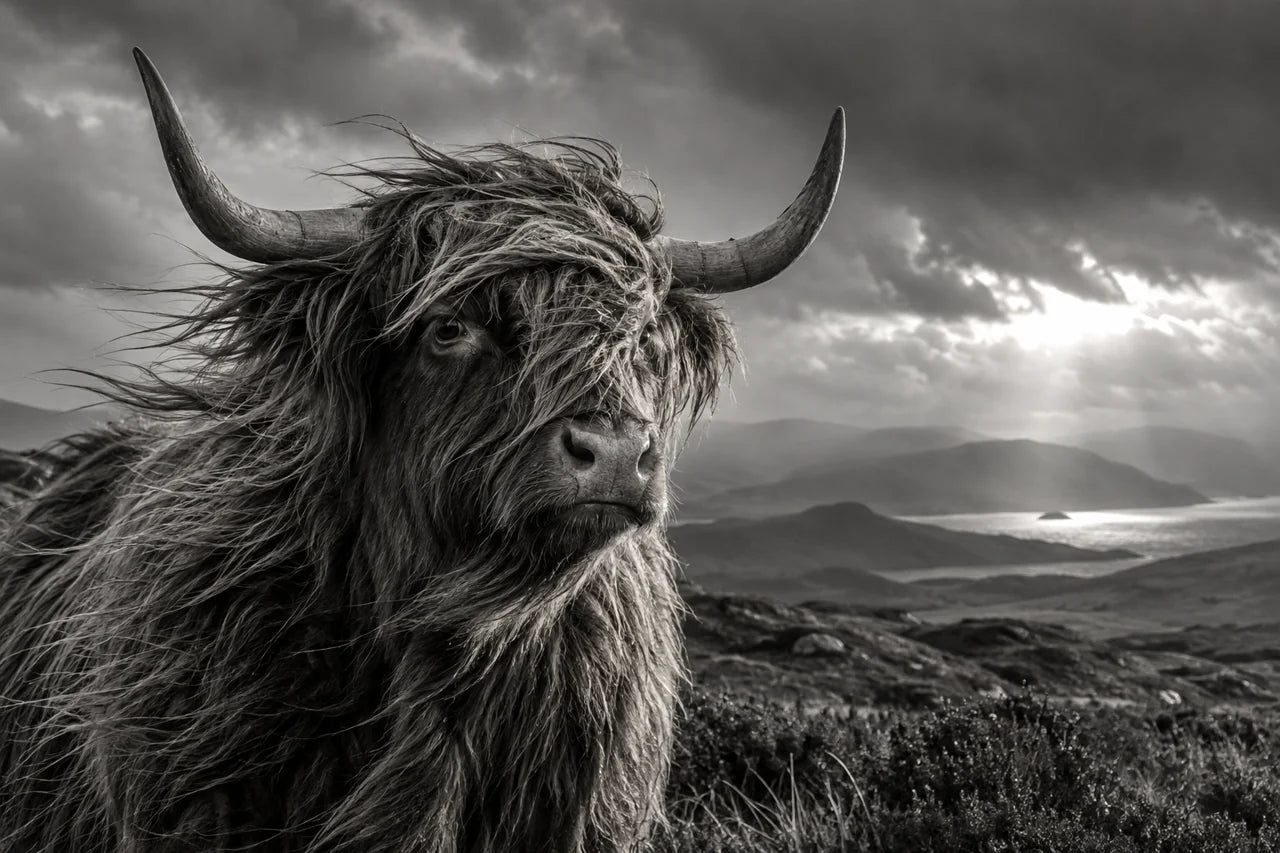
“An ultra-realistic black-and-white Highland cow photograph, dramatic enough to be the main print in my sitting room.”
Details about the fleeting moment, weather, light, framing and texture turn that starting idea into a more useful direction. Photographic describes the style; this is generated artwork, not a wildlife photograph taken on location.
What to attach
Nothing: this is a creation prompt from a description. No source photograph was used.
These are detailed example instructions, not a promise of identical results. Some pack prompts consolidate the original instructions. Adapt the references to your own files.
Create a breathtaking ultra-realistic black-and-white wildlife photograph of a Highland cow in the Scottish Highlands, a sophisticated sitting-room statement print. It should feel like an exceptional wildlife photographer's defining fleeting moment, believable as photography. THE MOMENT Single mature Highland cow on exposed moor as storm clears. Strong gust sweeps shaggy strands consistently sideways. Head turns slightly toward camera as a break in clouds sends soft directional light across face and horns. Calm powerful presence, mouth closed natural expression, no aggression or theatrical human emotion. ANATOMY Authentic broad muzzle substantial head thick shaggy forelock naturally spaced eyes partly shaded by hair, two convincing sweeping horns with natural asymmetry. Entire tips within frame. Real body weight and build, no oversized horns miniature body elongated face fantasy features. COMPOSITION Landscape 3:2, close environmental portrait head shoulders upper body, eye-level subtly low viewpoint medium-telephoto natural perspective no wide-angle distortion. Slightly off-centre with breathing room toward turned head, horns against quieter sky. Face focal point body landscape progressively softer. Comfortable crop space above/beside horns, no cut tips or crowded edges. LIGHT AND WEATHER Believable break in storm clouds lights one side face upper muzzle and selected strands, other side gentle shaded detail. Fine coat moisture few subtle droplets, no rain streaks spotlight glow or theatrical multiple light shafts. Heavy layered cloud lighter opening horizon, sky contrast secondary. LANDSCAPE Remote moor rough grasses dark heather distant hills partly softened low mist. Sparse foreground uncluttered, atmosphere and scale without competition. No buildings fences roads humans other animals objects. MONOCHROME AND FINISH True neutral black and white no sepia blue tint selective colour. Rich blacks luminous highlights wide subtle greys, separate fur through light/tones. Detail dark coat bright sky no crushing clipping harsh HDR clarity. Fine-art photographic restraint very subtle natural grain. Coarse individual hairs tangled strands whiskers realistic horn texture naturally moist muzzle. Eye muzzle main features sharp gentle movement in loose strands. No artificial cutout blur painting CGI illustration fantasy poster. Timeless dramatic quiet space. No comedy clothing accessories text logos watermarks borders frames. Return only finished photograph highest available native resolution.Copy uses the complete text above, including your edits. If automatic copying is unavailable, select this text and copy it manually.
CHANGE THE ATMOSPHERE
Once you have a composition you love, you can ask for a focused edit. We changed the season, colour and atmosphere—copper fur, winter mist and frost—to create a quieter piece from the same starting image.
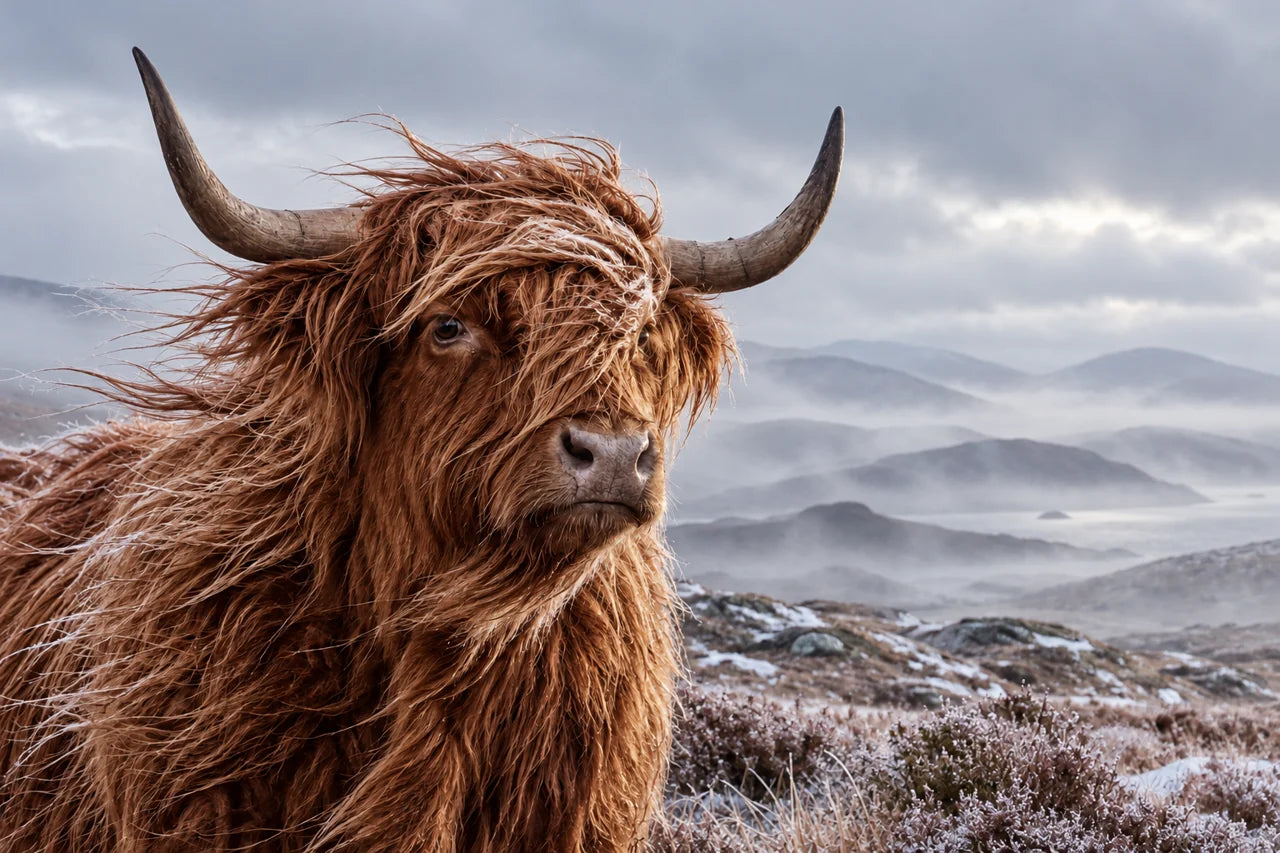
“Keep this cow and composition. Make it a full-colour winter morning with drifting mist.”
Say both what should change and what should stay. Upload the version you want edited, then compare important details. Generative editing does not guarantee exact pixel preservation.
What to attach
Attach the monochrome AI-created cow image you want edited. It is the composition reference, not an original camera photograph.
These are detailed example instructions, not a promise of identical results. Some pack prompts consolidate the original instructions. Adapt the references to your own files.
Edit this existing Highland cow photograph into a full-colour winter scene with drifting mist. Preserve the exact same cow, identity, anatomy, head angle, expression, horn shapes, windblown hair, position and scale. Keep the camera viewpoint, landscape framing, horizon and arrangement of the distant hills unchanged. Transform only the season, atmosphere, lighting and colour. Replace the clearing storm with a quiet winter morning. Let soft layers of cold mist drift across the distant hills and settle into the valleys, partly obscuring the background while keeping the cow's face clearly visible. Add a delicate coating of frost to the foreground grasses and heather, with small, irregular patches of snow caught between them. Preserve the underlying terrain. Avoid a deep blanket of snow. Restore believable natural colour: a rich copper-brown Highland cow, muted winter grasses, subdued earth tones and cool grey mist. Keep the cow's nose naturally dark and its horns realistic. Do not tint the entire photograph blue. Replace the dramatic break in the clouds with soft, diffused winter daylight from the same direction. Keep subtle highlights on the fur, gentle facial shadows and clear detail in the eye and muzzle. Add just a few fine frost crystals to the outer tips of the longest hairs. Keep the face, eyes and nostrils free of snow and ice. No heavy snowfall, frozen beard or exaggerated effects. Retain the original photographic realism, fine fur detail and natural depth. The result should feel like the same photographer captured the same composition in another season. Keep the original landscape 3:2 format. No additional animals, objects, buildings, text, borders or watermarks. Return only the edited photograph at the highest available native resolution.Copy uses the complete text above, including your edits. If automatic copying is unavailable, select this text and copy it manually.
A LITTLE GUIDANCE
Useful detail beats a longer wish list. More specific information can guide results, but length alone and repeated “best quality” phrases do not guarantee improvement. Avoid contradictory requests.
Say who or what matters. For a real pet, identify the original as the likeness reference and specify markings and expression to preserve.
Kitchen, moor, farmhouse or garden: mention what belongs there and what to remove.
Calm, dramatic, affectionate or playful. Mood and medium are different: a humorous scene can still look photographic.
Photographic, watercolour, illustration or graphic: specify one clear direction.
Soft window light, overcast winter daylight or warm evening sun changes the atmosphere.
Choose full colour, neutral monochrome or a restrained palette matching your room. Describe accents rather than recolouring your pet.
Portrait, landscape or square; close-up or full scene. Leave room around ears, horns and other important details.
Request natural anatomy and believable support. Inspect eyes, paws, mouths, horns and object placement.
Say which detail must draw the eye and whether the background should be quieter.
A LITTLE GUIDANCE
Consistency comes from giving every reference a clear job.
Use the same original pet photograph for each image. It supplies likeness, markings and anatomy.
After the first result, attach it as the style reference for the others. Explain that it guides light, palette and finish, not identity.
Keep orientation, colours, lighting and subject scale consistent. Change the action or setting, generate separate finished files and review them together.
3 for 2 on canvas & poster prints can suit a matching set. Lowest-priced qualifying base print free; frames and extras are charged separately.
A LITTLE GUIDANCE
You don’t need to rewrite everything when one detail feels wrong. Point to the change you want and protect what already works.
Suggested correction
Keep everything else. Reduce the reflection in the eyes and preserve their natural shape and colour.
Suggested correction
Keep the face, markings and composition. Make the background simpler.
Suggested correction
The paws look stretched. Correct their anatomy and position without changing the face.
Suggested correction
Keep the image's mood. Add more space around the horns so they aren't close to the edges.
Edits may affect other details, so compare each result. Save versions you like before trying another. If a result drifts away from your pet, return to the original photo and restate the likeness constraints.
A LITTLE GUIDANCE
A different source photo can help more than an increasingly complicated prompt. You do not need to stage the final scene in real life.
Choose a sharp view with visible eyes and distinctive markings. Avoid motion blur, heavy filters and strong flash glare.
Do not crop off ears or paws if your intended scene needs them. Use natural, even light where possible.
Use the highest-resolution original available. A screenshot or messaging-app copy can lose useful detail.
A LITTLE REASSURANCE
For your own pet’s likeness, upload a clear original photograph. For invented wildlife or landscape artwork, a description is enough—as in the Highland cow creation example.
No. Start simply and ask ChatGPT to help develop your idea. Relevant details about the subject, setting, style and framing help; length alone does not.
Yes. Adapt subject-specific details to your pet and attach the required original and style references. Read the reference notes for each example. Copy includes your current edits; results vary.
A clear reference and explicit likeness instructions help, but exact likeness is not guaranteed. AI can change markings, eyes, proportions or expression. Compare the result with your original before printing.
Yes. The Highland example uses a photographic style with a dramatic mood. Photographic style and playful humour are separate choices; describe the feeling you want.
Yes. Say what should change and what should stay, then inspect the edit. Room accent colours can change without asking to recolour your pet. Save a version you like before experimenting.
Yes. Reuse the identity photograph and an approved style reference, keeping orientation, subject scale, light and palette consistent. Create separate files and compare them together; small variations can still occur.
You can adapt the animal, feature descriptions and anatomy instructions. Remove dog-specific assumptions and check the result carefully. The illustrated dog examples were not also tested on cats.
Ask for a focused correction and say what should remain. If several details have drifted, return to the source photograph and your saved prompt rather than repeatedly editing an unsuitable result.
It depends on actual pixel dimensions, detail and crop. Review your chosen size in the print builder and consult our print guidance. If unsure, contact sales@yourimage2canvas.co.uk with the file and intended size. There is no blanket large-print guarantee.
This guide helps you create and refine artwork separately in ChatGPT. Upload your chosen finished file for YI2C to print. AI generation is not included in the print builder or your print order; this guide does not imply an OpenAI partnership.
No. These examples demonstrate a direction, not a guaranteed identical output. Detailed prompts and reference images guide generation but do not ensure that every instruction is followed exactly.
Access, limits and features depend on your account and may change. Check the service’s current information; this guide does not promise free or unlimited image generation.
FROM SCREEN TO PRINT
A few careful checks help you choose a print that suits the file you have.
Check likeness, eyes, paws, teeth, horns, repeated objects, accidental text and background artefacts.
Use the highest available native-resolution download. Avoid screenshots, messaging-app copies and repeated resaving.
3:4 is portrait, 3:2 landscape and 1:1 square. Product shapes differ: review the builder crop and leave breathing room around heads, ears and horns. Canvas wraps need extra consideration.
Resolution means actual pixels, not just a “300 dpi” label or file size. Asking for high resolution does not guarantee every print size. Use our guidance or email the workshop if unsure.
Upload the finished artwork through the existing photo-print builder, choose canvas or poster and check the preview. YI2C prints your supplied artwork; AI creation happens separately in ChatGPT.
3 for 2 on canvas & poster prints: lowest-priced qualifying base print free; frames and extras charged separately. Offer details. Free UK delivery on physical prints; order before 2pm Monday–Friday for dispatch on a 24-hour service. Next-working-day arrival is expected, not guaranteed; bank holidays and exclusions apply. Delivery details.
Turn your finished artwork into canvas prints or posters, printed, checked and packed in our family-run West Yorkshire workshop.
Create your print ↗