Your idea
“Make Lulu a superhero for Dad’s birthday.”
3 FOR 2 ON CANVAS PRINTS · FREE EXPRESS DELIVERY


ONE PHOTO. A WHOLE NEW WORLD.
A rooftop hero. A biscuit-stealing mastermind. The star of their very own comic. Start with a photograph, tell AI what you have in mind, and turn a little idea into something wonderfully personal.
These six examples all began with the same photograph of Lulu. They are starting points, not a menu of limits. Change the character, setting, colours, wording or entire artistic style to suit the person you are making it for.
Explore the six ideas ↓Help me develop my ideaPersonalised canvas prints from £14.99, including delivery.
A5 slim canvas · delivery details
ONE FAMILIAR FACE
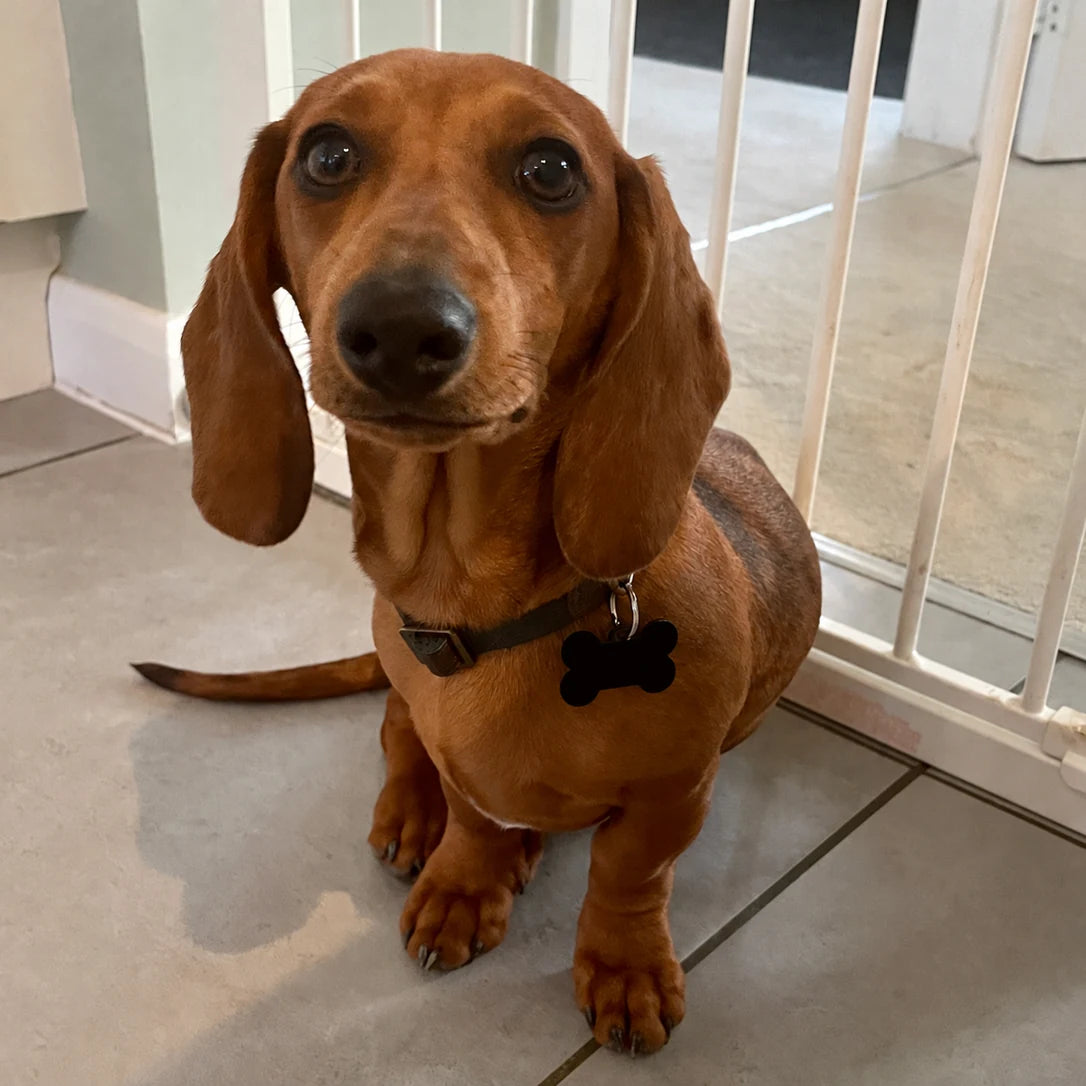
A good source gives the tool a starting point for likeness. It can still change details: compare eyes, muzzle, ears and markings rather than assuming an exact reproduction.
Lulu is our example. Your own pet, family jokes, favourite colours and interests are the ingredients that make the idea personal.
Photographic light · a name as a title
Painted comic atmosphere · no wording
A personal message · 3D-style direction
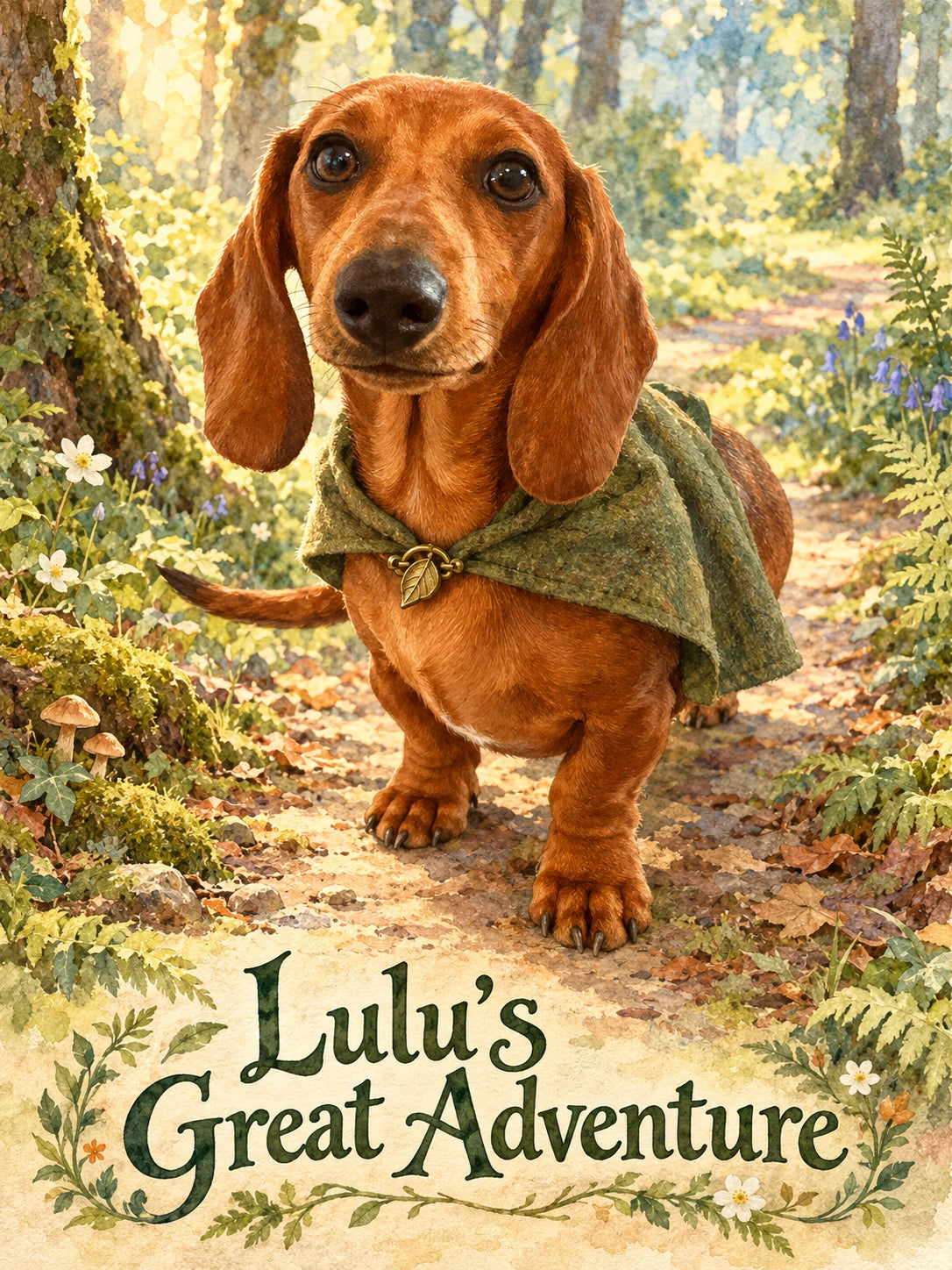
Painted textures · storybook mood
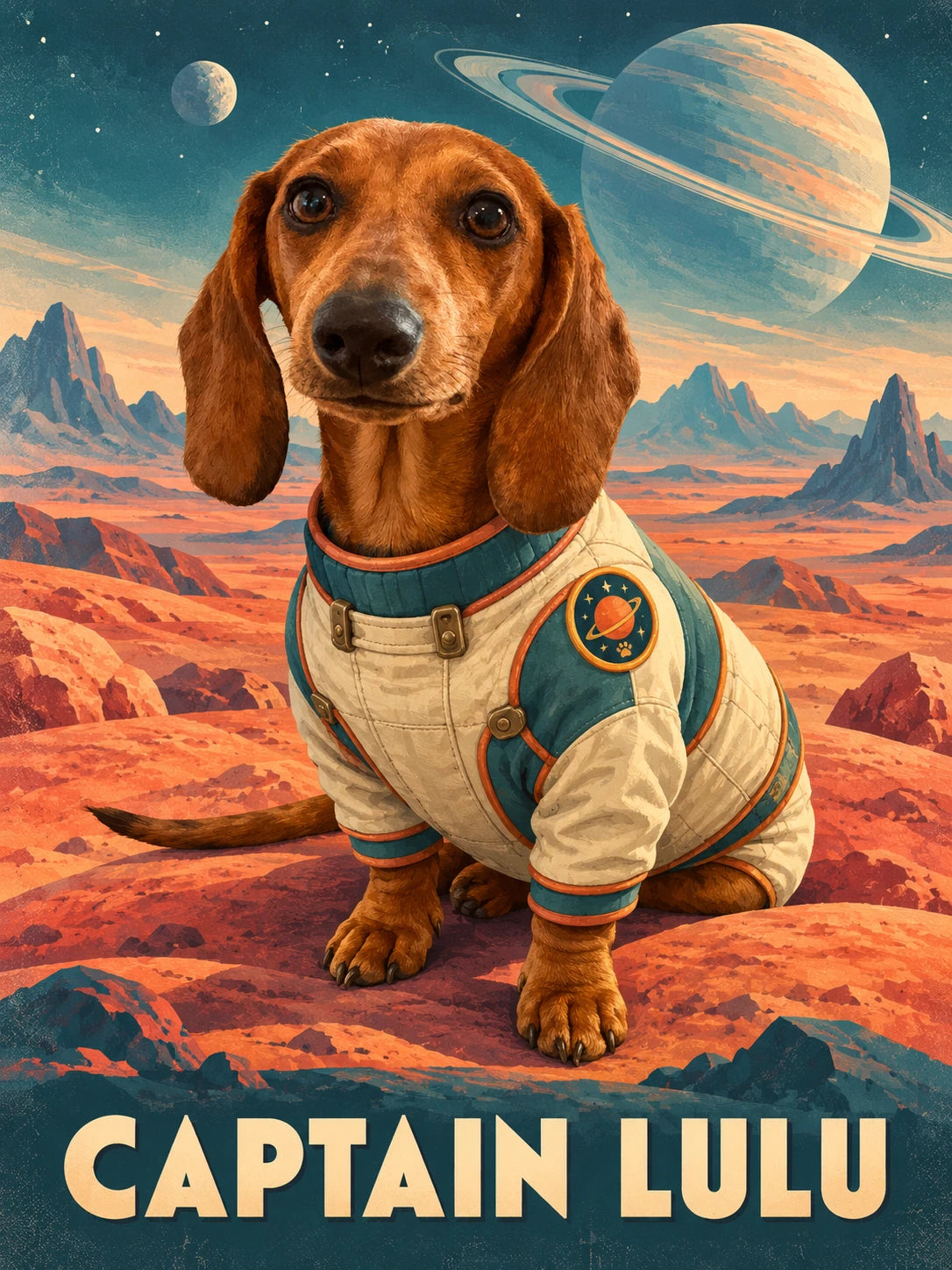
Retro graphics · a controlled palette
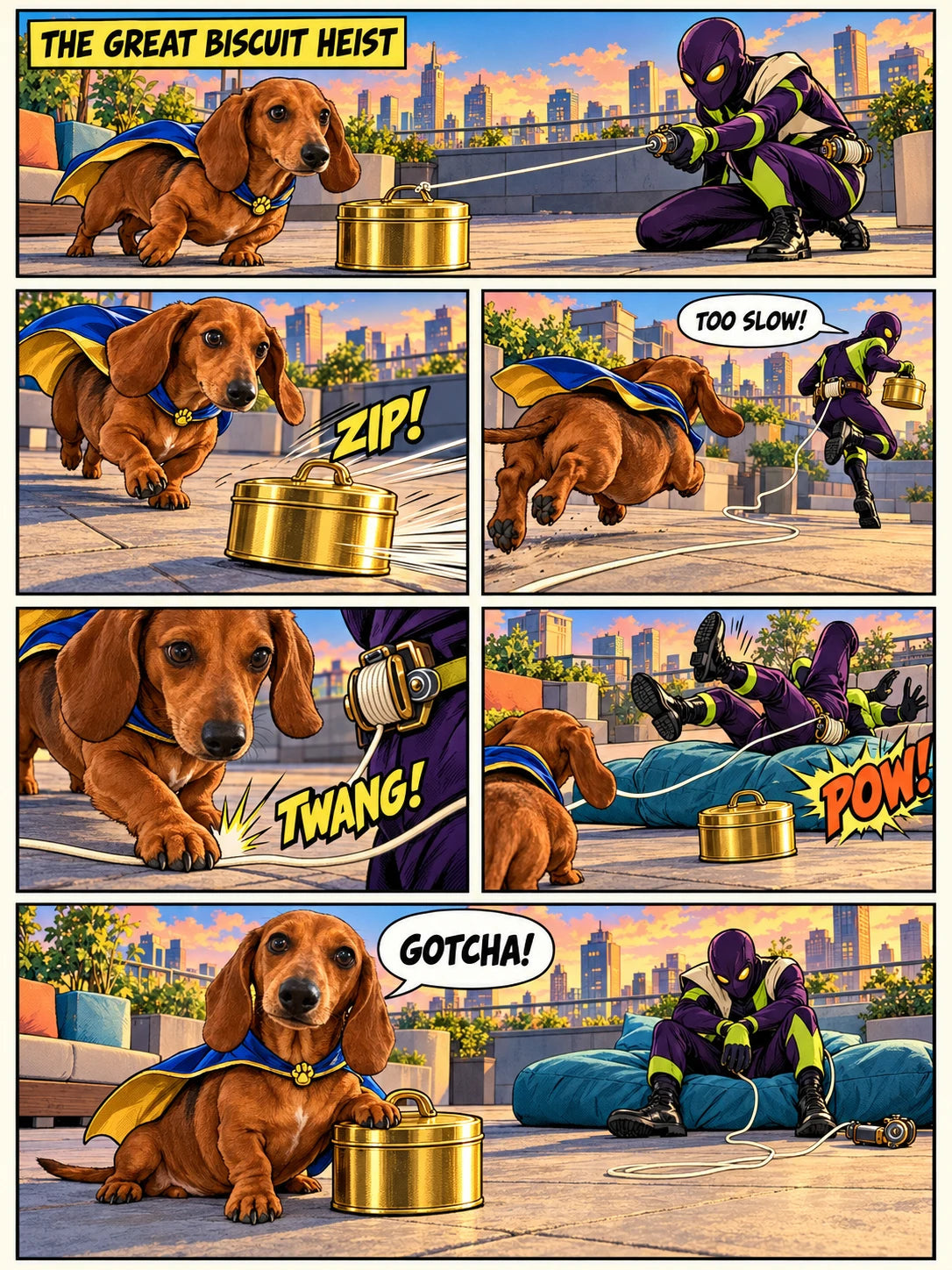
Six panels · one complete story
MAKE IT YOURS
Use everyday words. Spelling need not be perfect: ask AI to organise your thoughts, suggest directions and help you write the prompt. Useful priorities matter more than piling on adjectives.
“Make Lulu a superhero for Dad’s birthday.”
“This is Lulu. I want a funny superhero picture for Dad’s birthday. Keep her recognisable. Suggest three original scenes and artistic styles, then help me write a detailed image prompt. Include room for a short message. Ask me about anything that would improve the result.”
An original midnight-teal cape, sunset rooftop, realistic dog anatomy, warm light, full ears and paws, portrait framing and Dad’s personal message.
Replace the bracketed details.
I have a photograph of my pet and want to make a thoughtful gift for [recipient] for [occasion]. They love [interests] and their room uses [colours]. Suggest five unusual ideas across different artistic styles, keeping my pet recognisable. Then help me develop my favourite into a detailed prompt.
Compare three approaches before choosing.
I know the mood I want but not the style. Give me three ways to depict [subject] in [setting]: one photographic, one painted and one graphic. Explain the difference in plain English.
Ask only what matters.
Help me turn this idea into a clear image prompt: [idea]. Prioritise [likeness/anatomy/text/mood]. Ask only the questions needed to make it better.
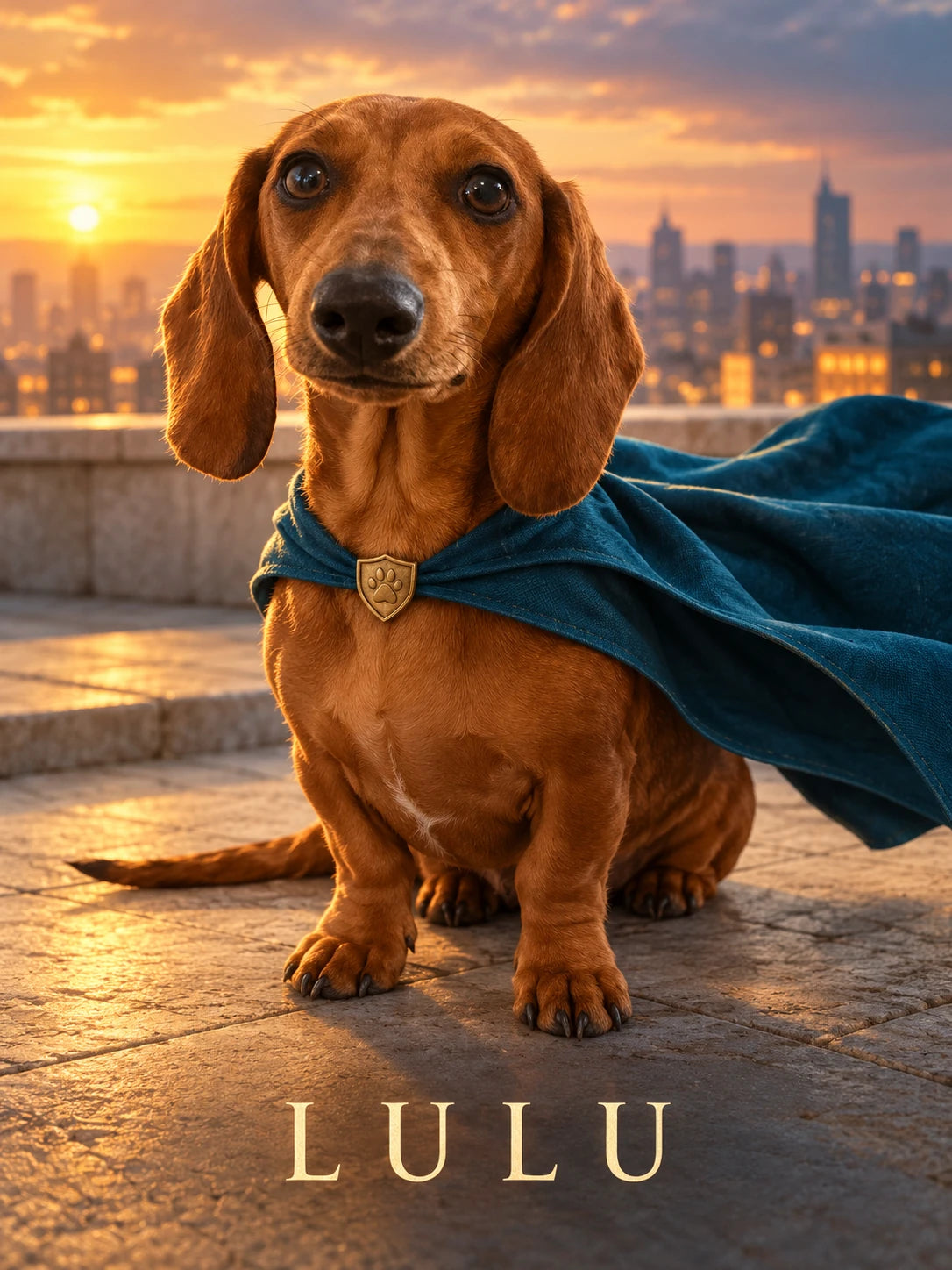
01 · Photographic light · a name as a title
The cape makes the character; the familiar face makes it yours. Warm sunset light and a restrained original costume turn a household photograph into a cinematic portrait.
Character, lighting and background can transform the mood without replacing your pet’s identity.
Attach your original pet photograph.
It supplies identity and anatomy. These browser controls prepare text; paste it into ChatGPT or your chosen image tool with your photo attached. Nothing is generated here.
The supplied prompts consolidate the original instructions; they are not transcripts or guarantees of identical results. Names and lettering update the full prompt below. Changing these fields rebuilds it, so make any direct text edits afterwards.
Create a premium PHOTOREALISTIC original cinematic superhero portrait of Lulu seated naturally on a broad pale-stone rooftop terrace safely away from the edge. Hindquarters supported, two separate paws beneath shoulders, head slightly towards camera. Midnight-teal woven cape comfortable shoulder fastening, small original brushed-gold shield clasp with paw impression. Chest marking visible; cape falls behind and lifts gently right in consistent breeze, clear of ears and paws. No bodysuit, mask or armour. Softly blurred plausible city behind low parapet, warm windows and atmospheric blue-grey haze; no identifiable landmarks or readable signs. Sunset light upper left, natural copper coat, teal muted gold pale stone palette. Fine fur whiskers nose texture and natural portrait lens perspective. Restrained contrast and realistic fabric, no waxy fur HDR or crunchy sharpening. Exactly one title LULU, elegant widely spaced warm-ivory uppercase, centred below paws on a darker terrace area with generous bottom margin. No other wording. REFERENCE AND IDENTITY Use the attached original pet photograph as the primary reference for identity and anatomy. For this example the pet is Lulu. Follow the photograph over any written description. Preserve her reddish-brown short coat, long broad muzzle, black nose, natural brown eyes and spacing, broad floppy ears, actual head shape, tiny white chest marking and individual asymmetry. Keep her gently curious closed-mouth expression. Do not substitute a generic dog, enlarge eyes, shorten the muzzle or add a human smile. Remove the collar and identification tag completely; do not reproduce any tag information. ANATOMY Preserve the actual long body and short legs. Natural canine posture and physically supported paws; no human torso, arms, hands, fingers or extra limbs. Both ears remain freely visible. Costumes must fit the dog rather than alter her body. COMPOSITION AND FINISH Create portrait 3:4 artwork at the dog's eye level. Keep the dog large and immediately recognisable, with face upper-middle, complete ears and both front paws inside the frame, comfortable margins above and beside the head and below any wording for later print cropping. Use coherent contact shadows, perspective and light. Preserve natural brown eyes with small restrained highlights, no glowing pupils. No branded characters, existing franchise costumes or logos, watermarks, frames or extra animals. Return only the finished artwork at the highest available native resolution. Prioritise likeness, anatomy, specified medium and correctly spelled wording.For a cat or another pet, use the separate adaptation request below. Do not merely rename Lulu while leaving her anatomy in the prompt.
These are separate revision requests. Copy one after creating an image, or ask the tool to rewrite the complete prompt before generating. This avoids mixing conflicting styles into the original prompt.
Suggested edits—not additional generated examples.
Keep everything else unchanged, change the cape to forest green and the title to OSCAR.
Remove all wording. Preserve the pet, cape and rooftop, with generous cropping space.
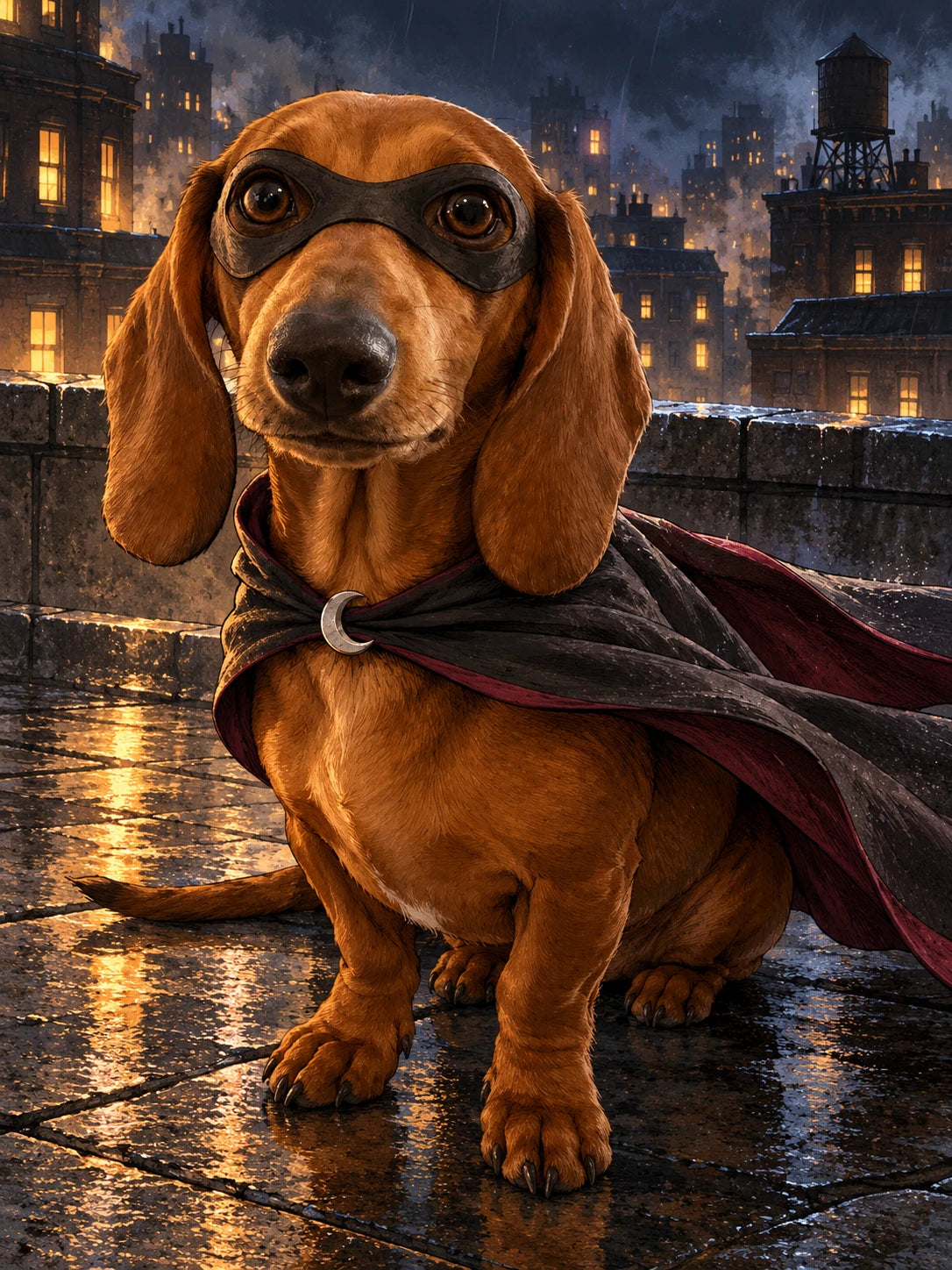
02 · Painted comic atmosphere · no wording
A darker world, with painted shading and confident ink. An original mask and cape suggest a guardian without borrowing a familiar franchise costume.
Character and medium are separate choices. Comic illustration can be atmospheric without exaggerated eyes.
Attach your original pet photograph.
It supplies identity and anatomy. These browser controls prepare text; paste it into ChatGPT or your chosen image tool with your photo attached. Nothing is generated here.
The supplied prompts consolidate the original instructions; they are not transcripts or guarantees of identical results. Names and lettering update the full prompt below. Changing these fields rebuilds it, so make any direct text edits afterwards.
Create a sophisticated COMIC-BOOK ILLUSTRATION of Lulu as an original nighttime guardian. Confident varied ink outlines, layered painted shading, selective graphic shadows and subtle print texture; clearly illustration, not photo or flat children's cartoon. Seated naturally on broad damp stone terrace after a light shower, body angled face towards viewer. Charcoal cape muted burgundy lining small brushed-silver crescent clasp, white chest marking visible. Slim charcoal mask fitted lightly above muzzle, generous eye openings preserve facial spacing and expression; nose and floppy ears free. No pointed costume ears, armour or bodysuit. Low parapet behind dog, receding varied city buildings distant water tower amber windows and thin mist layers. Few fine rain streaks background only, subtle puddle reflections. Midnight blue charcoal burgundy natural copper palette. Soft amber light left and faint cool reflected fill, readable shadows no neon glow. No text at all. REFERENCE AND IDENTITY Use the attached original pet photograph as the primary reference for identity and anatomy. For this example the pet is Lulu. Follow the photograph over any written description. Preserve her reddish-brown short coat, long broad muzzle, black nose, natural brown eyes and spacing, broad floppy ears, actual head shape, tiny white chest marking and individual asymmetry. Keep her gently curious closed-mouth expression. Do not substitute a generic dog, enlarge eyes, shorten the muzzle or add a human smile. Remove the collar and identification tag completely; do not reproduce any tag information. ANATOMY Preserve the actual long body and short legs. Natural canine posture and physically supported paws; no human torso, arms, hands, fingers or extra limbs. Both ears remain freely visible. Costumes must fit the dog rather than alter her body. COMPOSITION AND FINISH Create portrait 3:4 artwork at the dog's eye level. Keep the dog large and immediately recognisable, with face upper-middle, complete ears and both front paws inside the frame, comfortable margins above and beside the head and below any wording for later print cropping. Use coherent contact shadows, perspective and light. Preserve natural brown eyes with small restrained highlights, no glowing pupils. No branded characters, existing franchise costumes or logos, watermarks, frames or extra animals. Return only the finished artwork at the highest available native resolution. Prioritise likeness, anatomy, specified medium and correctly spelled wording.For a cat or another pet, use the separate adaptation request below. Do not merely rename Lulu while leaving her anatomy in the prompt.
These are separate revision requests. Copy one after creating an image, or ask the tool to rewrite the complete prompt before generating. This avoids mixing conflicting styles into the original prompt.
Suggested edits—not additional generated examples.
Keep this composition and dog identity; use brighter colours and a daytime city.
Remove only the mask. Keep the cape, pet identity and illustration style.
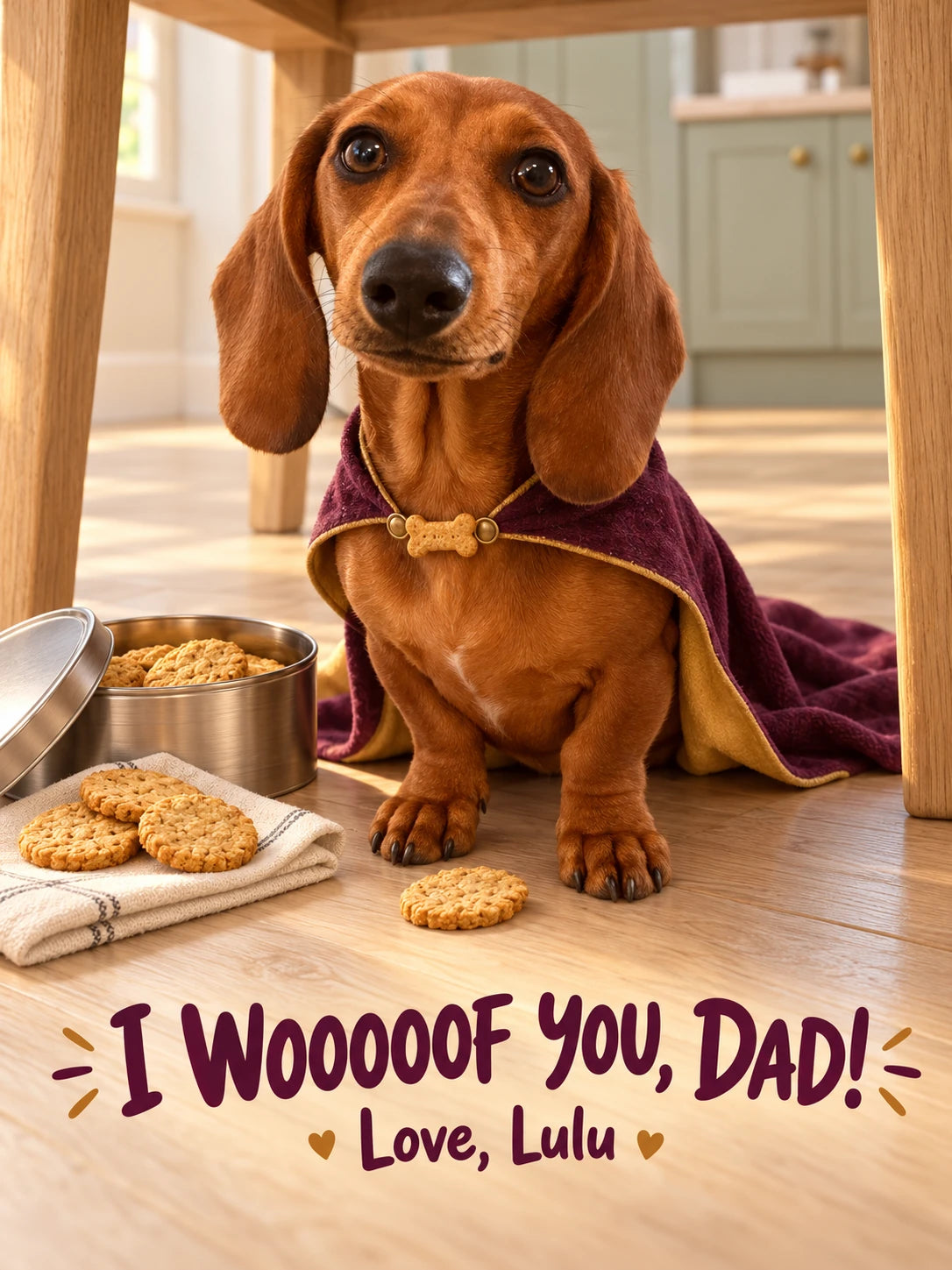
03 · A personal message · 3D-style direction
The private joke is the personalisation. The prompt asks for a warm, tactile 3D-style direction; this supplied result remains quite realistic. Compare the output with your intended medium.
Exact wording deserves as much checking as likeness. Short messages are easier to read and place.
Attach your original pet photograph.
It supplies identity and anatomy. These browser controls prepare text; paste it into ChatGPT or your chosen image tool with your photo attached. Nothing is generated here.
The supplied prompts consolidate the original instructions; they are not transcripts or guarantees of identical results. Names and lettering update the full prompt below. Changing these fields rebuilds it, so make any direct text edits afterwards.
Create a premium original 3D ANIMATED portrait of Lulu as The Biscuit Bandit, a harmless little mastermind under a pale-oak kitchen table. Clearly polished dimensional animation with tactile materials and subtle stylisation, not photography or flat cartoon. Preserve identity without exaggerated eyes or cheeks. Naturally seated wooden floor, open small unbranded brushed-metal biscuit tin with several plain golden oat biscuits, lid beside it; three biscuits on folded ivory cotton napkin and one apart in front of paws. Mouth closed innocent expression. No chocolate or paws holding food. Short plum cape muted gold lining biscuit-shaped clasp, realistic folds behind on floor clear of paws, chest visible. Two softly blurred table legs, cream kitchen muted sage detail beyond, bright uncluttered. Soft left daylight gentle under-table shade, copper cream oak sage plum gold. Detailed short fur believable paws matte irregular oat biscuits soft fabric and contact shadows, no cheap plastic render. Exactly two lines in clean lower floor area separate from paws and props: I WOOOOOF YOU, DAD! / Love, Lulu. First line larger playful, second smaller, deep plum readable straight correct text. No extra words. REFERENCE AND IDENTITY Use the attached original pet photograph as the primary reference for identity and anatomy. For this example the pet is Lulu. Follow the photograph over any written description. Preserve her reddish-brown short coat, long broad muzzle, black nose, natural brown eyes and spacing, broad floppy ears, actual head shape, tiny white chest marking and individual asymmetry. Keep her gently curious closed-mouth expression. Do not substitute a generic dog, enlarge eyes, shorten the muzzle or add a human smile. Remove the collar and identification tag completely; do not reproduce any tag information. ANATOMY Preserve the actual long body and short legs. Natural canine posture and physically supported paws; no human torso, arms, hands, fingers or extra limbs. Both ears remain freely visible. Costumes must fit the dog rather than alter her body. COMPOSITION AND FINISH Create portrait 3:4 artwork at the dog's eye level. Keep the dog large and immediately recognisable, with face upper-middle, complete ears and both front paws inside the frame, comfortable margins above and beside the head and below any wording for later print cropping. Use coherent contact shadows, perspective and light. Preserve natural brown eyes with small restrained highlights, no glowing pupils. No branded characters, existing franchise costumes or logos, watermarks, frames or extra animals. Return only the finished artwork at the highest available native resolution. Prioritise likeness, anatomy, specified medium and correctly spelled wording.For a cat or another pet, use the separate adaptation request below. Do not merely rename Lulu while leaving her anatomy in the prompt.
These are separate revision requests. Copy one after creating an image, or ask the tool to rewrite the complete prompt before generating. This avoids mixing conflicting styles into the original prompt.
Suggested edits—not additional generated examples.
Change only the message to “Happy Birthday, Mum!” / “Love, Rosie”; preserve the artwork.
Replace biscuits with tennis balls and remove all food. Preserve the pet and warm kitchen setting.
04 · Painted textures · storybook mood
Soft painted texture, a small travelling cape and a sunlit path create a gentler gift. The title gives it the feeling of a story waiting to begin.
Medium changes the feeling: watercolour washes and painted details create a softer world than photographic light.
Attach your original pet photograph.
It supplies identity and anatomy. These browser controls prepare text; paste it into ChatGPT or your chosen image tool with your photo attached. Nothing is generated here.
The supplied prompts consolidate the original instructions; they are not transcripts or guarantees of identical results. Names and lettering update the full prompt below. Changing these fields rebuilds it, so make any direct text edits afterwards.
Create premium hand-painted STORYBOOK woodland illustration of Lulu. Translucent watercolour washes, layered gouache details, visible restrained brushwork and delicate paper grain; not photo, 3D, vector or oil. Standing naturally on woodland path at entrance to sunny clearing, body angled along path head towards viewer, actual short legs all four paws coherent supported. Tail curves behind. Short moss-green travelling cape antique-brass leaf clasp weathered woven folds, no hood boots weapons. Chest mark visible. Slender trees moss ferns delicate flowers small mushrooms by path away face. Path curves behind; selectively tactile foreground then loose softer painted distance. Quiet magic from light not glitter glow or fantasy clutter. Upper-left morning sunlight warm highlights cool woodland shadows, copper moss sage cream ochre dusty blue. Economical short fur strokes careful eyes and muzzle, no heavy outlines. Exactly title Lulu’s Great Adventure in elegant readable deep-green storybook lettering integrated into quiet lower area away paws; clear apostrophe generous crop margins no box or scroll. REFERENCE AND IDENTITY Use the attached original pet photograph as the primary reference for identity and anatomy. For this example the pet is Lulu. Follow the photograph over any written description. Preserve her reddish-brown short coat, long broad muzzle, black nose, natural brown eyes and spacing, broad floppy ears, actual head shape, tiny white chest marking and individual asymmetry. Keep her gently curious closed-mouth expression. Do not substitute a generic dog, enlarge eyes, shorten the muzzle or add a human smile. Remove the collar and identification tag completely; do not reproduce any tag information. ANATOMY Preserve the actual long body and short legs. Natural canine posture and physically supported paws; no human torso, arms, hands, fingers or extra limbs. Both ears remain freely visible. Costumes must fit the dog rather than alter her body. COMPOSITION AND FINISH Create portrait 3:4 artwork at the dog's eye level. Keep the dog large and immediately recognisable, with face upper-middle, complete ears and both front paws inside the frame, comfortable margins above and beside the head and below any wording for later print cropping. Use coherent contact shadows, perspective and light. Preserve natural brown eyes with small restrained highlights, no glowing pupils. No branded characters, existing franchise costumes or logos, watermarks, frames or extra animals. Return only the finished artwork at the highest available native resolution. Prioritise likeness, anatomy, specified medium and correctly spelled wording.For a cat or another pet, use the separate adaptation request below. Do not merely rename Lulu while leaving her anatomy in the prompt.
These are separate revision requests. Copy one after creating an image, or ask the tool to rewrite the complete prompt before generating. This avoids mixing conflicting styles into the original prompt.
Suggested edits—not additional generated examples.
Change only the season to autumn, with rust and ochre leaves. Keep the pet’s likeness and painted style.
Remove the title and keep this as a quiet woodland portrait.
05 · Retro graphics · a controlled palette
A limited palette, simplified landscape and retro lettering take Lulu somewhere entirely imagined. Match the colours to the recipient’s room while keeping the real coat colour.
Fantasy needs consistent anatomy, light and composition; it does not need to be a literal real-world scene.
Attach your original pet photograph.
It supplies identity and anatomy. These browser controls prepare text; paste it into ChatGPT or your chosen image tool with your photo attached. Nothing is generated here.
The supplied prompts consolidate the original instructions; they are not transcripts or guarantees of identical results. Names and lettering update the full prompt below. Changing these fields rebuilds it, so make any direct text edits afterwards.
Create premium RETRO SCIENCE-FI ILLUSTRATION of Lulu as Captain Lulu. Vintage space-travel poster with refined hand-painted shading simplified graphic landscape shapes subtle screen-print grain and limited palette, not photo glossy 3D or damaged distressed poster. Naturally seated broad coral alien terrain body slightly angled face viewer. Tailored cream canine exploration suit teal panels burnt-orange piping metal fastenings stitched folds long torso SHORT leg openings uncovered paws, no bulky anatomy changes. Head ears uncovered, neckline below throat; original planet-and-paw shoulder emblem no readable badges helmet or agency logos. Rolling coral landscape sculptural rocks dusty-blue mountains, deep teal sky peach horizon one elegant ringed planet away head and small distant moon. Coherent ring near/far occlusion and consistent upper-left light. Few stars, uncluttered no rockets aliens buildings. Cream teal coral orange blue copper palette and readable cool shadows. Exactly CAPTAIN LULU bold crisp spaced warm-cream retro title on quiet darker lower foreground separate paws generous margins; no other words. REFERENCE AND IDENTITY Use the attached original pet photograph as the primary reference for identity and anatomy. For this example the pet is Lulu. Follow the photograph over any written description. Preserve her reddish-brown short coat, long broad muzzle, black nose, natural brown eyes and spacing, broad floppy ears, actual head shape, tiny white chest marking and individual asymmetry. Keep her gently curious closed-mouth expression. Do not substitute a generic dog, enlarge eyes, shorten the muzzle or add a human smile. Remove the collar and identification tag completely; do not reproduce any tag information. ANATOMY Preserve the actual long body and short legs. Natural canine posture and physically supported paws; no human torso, arms, hands, fingers or extra limbs. Both ears remain freely visible. Costumes must fit the dog rather than alter her body. COMPOSITION AND FINISH Create portrait 3:4 artwork at the dog's eye level. Keep the dog large and immediately recognisable, with face upper-middle, complete ears and both front paws inside the frame, comfortable margins above and beside the head and below any wording for later print cropping. Use coherent contact shadows, perspective and light. Preserve natural brown eyes with small restrained highlights, no glowing pupils. No branded characters, existing franchise costumes or logos, watermarks, frames or extra animals. Return only the finished artwork at the highest available native resolution. Prioritise likeness, anatomy, specified medium and correctly spelled wording.For a cat or another pet, use the separate adaptation request below. Do not merely rename Lulu while leaving her anatomy in the prompt.
These are separate revision requests. Copy one after creating an image, or ask the tool to rewrite the complete prompt before generating. This avoids mixing conflicting styles into the original prompt.
Suggested edits—not additional generated examples.
Keep the composition and likeness; use navy, cream and raspberry instead of teal and coral. Preserve the pet’s coat colour.
Change only the title to CAPTAIN IVY. Preserve the artwork.
06 · Six panels · one complete story
A beginning and a problem. A chase and a clever solution. A happy ending. The full prompt describes every panel, keeping costume, rooftop, tin and cord consistent.
Review reading order, bubble tails, limbs, prop continuity and every letter: ZIP!, TOO SLOW!, TWANG!, POW!, GOTCHA! The supplied result is an example, not proof that every instruction was followed.
Attach your original pet photograph.
It supplies identity and anatomy. These browser controls prepare text; paste it into ChatGPT or your chosen image tool with your photo attached. Nothing is generated here.
The supplied prompts consolidate the original instructions; they are not transcripts or guarantees of identical results. Names and lettering update the full prompt below. Changing these fields rebuilds it, so make any direct text edits afterwards.
Create an exceptional full-page SIX-PANEL professional sequential superhero comic, one complete story on ONE portrait page. Top wide panel, two panels row 2, two panels row 3, bottom wide panel. Clean warm-ivory gutters, left-right then down reading, outer print margins. Bold controlled inks varied line weights painted brush shading selective halftones, cobalt gold purple lime coral turquoise palette. Same secure city rooftop late-afternoon light throughout, coherent scale props perspective. Not unrelated portraits or photo montage. Lulu wears short cobalt cape gold lining small gold paw clasp, bare head ears, recognisable dog in every panel. Original slender human-sized masked trickster wears aubergine-purple acid-lime suit asymmetric ivory shoulder panel smooth mask small amber oval lenses. Compact mechanical belt spool and handheld device release ivory filament, consistent throughout. No familiar franchise suits web-patterned bodysuit oversized white eye shapes or wrist-shooting pose. No injury weapons or frightening violence. Panel 1 wide: Lulu beside golden closed biscuit tin with handle; opposite rival crouches aiming filament device, cord attaches tin handle. Caption THE GREAT BISCUIT HEIST. Panel 2 left: same tin slides on stone pulled by taut filament toward rival, Lulu turns starting step ears swing. Sound ZIP! Panel 3 right: Lulu runs naturally on four canine legs after rival retreating right carrying tin; loose filament trails from belt spool across floor, cape streams. Rival bubble TOO SLOW! with correct tail. Panel 4 left: close natural dog paw pins trailing cord to stone; cord taut towards visible rival belt spool. Sound TWANG! Panel 5 right: tightened cord interrupts rival escape, harmless tumble onto large soft rooftop cushion visibly compressing, coherent limbs; closed tin lands upright nearby. Sound POW! Panel 6 wide: Lulu seated beside recovered tin paw naturally touching side, recognisable curious expression; rival slumped unharmed on cushion background gadget beside. Lulu bubble GOTCHA! with correct tail. ONLY these words once each in assigned panels, clean professional readable lettering away faces paws and cord action. Clear causal story consistent identity costume tin cord; no invented words watermark borders book mockup or extra characters. REFERENCE AND IDENTITY Use the attached original pet photograph as the primary reference for identity and anatomy. For this example the pet is Lulu. Follow the photograph over any written description. Preserve her reddish-brown short coat, long broad muzzle, black nose, natural brown eyes and spacing, broad floppy ears, actual head shape, tiny white chest marking and individual asymmetry. Keep her gently curious closed-mouth expression. Do not substitute a generic dog, enlarge eyes, shorten the muzzle or add a human smile. Remove the collar and identification tag completely; do not reproduce any tag information. ANATOMY Preserve the actual long body and short legs. Natural canine posture and physically supported paws; no human torso, arms, hands, fingers or extra limbs. Both ears remain freely visible. Costumes must fit the dog rather than alter her body. COMPOSITION AND FINISH Create portrait 3:4 artwork at the dog's eye level. Keep the dog large and immediately recognisable, with face upper-middle, complete ears and both front paws inside the frame, comfortable margins above and beside the head and below any wording for later print cropping. Use coherent contact shadows, perspective and light. Preserve natural brown eyes with small restrained highlights, no glowing pupils. No branded characters, existing franchise costumes or logos, watermarks, frames or extra animals. Return only the finished artwork at the highest available native resolution. Prioritise likeness, anatomy, specified medium and correctly spelled wording.For a cat or another pet, use the separate adaptation request below. Do not merely rename Lulu while leaving her anatomy in the prompt.
These are separate revision requests. Copy one after creating an image, or ask the tool to rewrite the complete prompt before generating. This avoids mixing conflicting styles into the original prompt.
Suggested edits—not additional generated examples.
Replace the stolen biscuit tin with Dad’s missing TV remote. First develop a new six-panel storyboard with a clear problem, clever solution and ending; do not simply swap one object.
Keep the six-panel story and character designs. Correct only any inconsistent cord, tin, costume or speech-bubble tail; preserve the panel order.
MAKE IT YOURS
Try asking for one focused change. These are suggested edits, not additional illustrated results. “Keep everything else” expresses intent, not a pixel-perfect guarantee.
Keep identity as the anchor.
Keep the same dog, pose and composition; change the city rooftop to a windswept Yorkshire moor and remove the costume.
Change the visual language.
Keep the likeness and scene; render this as a bold ink-and-halftone comic illustration instead of photography.
Protect the image you already like.
Change only the message to [exact wording]. Preserve the dog, scene, colours and layout.
Preserve the real coat colour.
Keep everything else; change the palette to [colours] so it suits my sitting room. Preserve the pet’s coat colour.
No need for a joke.
Keep this character, but make the scene calmer and more sophisticated, with no jokes or wording.
If several changes are needed, list priorities and refine in steps. If only lettering fails, fix only lettering. Reattach the original identity photo if likeness starts to drift.
MAKE IT YOURS
The most memorable idea may be the smallest detail: the sock they always steal, the chair they think belongs to them, or the phrase your family uses. Start there. Your artwork can be brilliantly silly, quietly beautiful or somewhere between.
editorial photography.
eccentric storybook.
regal painted portrait.
vintage horticultural poster.
warm illustrated scene, original labels.
playful comic.
atmospheric painting.
refined illustration.
cinematic evening scene.
nostalgic travel illustration.
retro sci-fi.
ink noir.
gently funny sports poster.
original comic story.
graphic adventure.
sunlit illustration.
tactile 3D-style scene.
ornate storybook.
quiet painting.
gentle watercolour.
serene night art.
isometric fantasy illustration.
painted storybook.
original gig-poster artwork.
These are starting ideas, not generated examples. Change names, places, possessions and palette. Avoid franchise logos and readable brand packaging. Personal decisions can make the result distinctive; exclusivity cannot be guaranteed.
MAKE IT YOURS
Use the name, recipient and wording controls in each example. The separate revision request lets you add mood and occasion. No pressure to be funny—or to add any lettering.
I wooooof you, Dad! / Love, Lulu
You’re pawsome, Mum
Happy birthday to my favourite human
Thanks for all the walks
Officially my favourite person
Best Dad. Best walks. Best biscuits.
For all our adventures
Always by your side
Home is wherever you are
Quote exact spelling and capitalisation. Ask for high contrast and a clear area. Keep words away from edges and canvas wrapping; proofread dates and unusual names character by character.
MAKE IT YOURS
A clear priority and a few useful details give the tool a direction. Contradictory repetition and a longer wish list do not guarantee a better result.
Attach the original for likeness. If using another image for style, say so. Breed alone misses individual markings.
Use photo one for my pet’s identity and photo two only for the artistic style. Likeness matters more than costume detail.
Photography describes camera, light and materials; painting describes brushwork; 3D style describes dimensional materials; retro posters simplify shape and palette.
Show me three approaches to this same scene: photographic, painted and graphic. Explain each in plain English.
A hero, observer, adventurer or mischief-maker is independent of artistic medium. Costumes must fit actual anatomy.
Make my pet a quiet observer, with a simple cape that fits their real body and leaves ears and paws visible.
Place, time, weather and a few props are enough. A background should support the story.
Use a sunlit kitchen with one favourite mug. Remove distracting props and signs.
Choose two to five colours, keep the coat natural, and explain the role of a room reference.
Use cream, navy and muted raspberry in the setting. Preserve the pet’s natural coat colour.
Gentle humour, cosy, dramatic, sentimental or sophisticated: there is no requirement to be quirky.
Make it calm and affectionate, without exaggerated expressions or jokes.
Portrait, landscape and square describe shape, not resolution. 3:4 may crop differently on A-series or another canvas ratio.
Keep complete ears and paws in view, with extra space around them and any lettering for the final product crop.
Readable eyes and fur matter more than glowing highlights.
Use soft window light from the left and small natural eye reflections, without artificial glowing pupils.
Fewer words usually make a clearer composition.
Place the exact words “Always by your side” in a quiet, high-contrast lower area, safely away from edges.
Review anatomy, expression, props and wording after every generation.
Likeness and natural anatomy matter more than elaborate costume detail. Keep the face and markings recognisable.
MAKE IT YOURS
A household background is fine: it can be replaced. A clear face and recognisable markings are more useful than staging a costume scene.
Choose visible eyes and ears, natural daylight and minimal motion blur. Eye-level photographs can help. Avoid screenshots when you have the original file.
A second clear photo may help with tricky markings; identify the primary reference. Do not expect a blurred file to reveal details that were never recorded.
Ask to remove collars and tags; there is no need to take a new photo just for that. Before sharing images publicly, obscure identification details and check the exported file.
A LITTLE REASSURANCE
No. Start naturally and ask for help developing your idea. The examples supply detail, but you can adapt them. Specify priorities rather than repeating adjectives.
Yes. Use the animal-and-features revision request to rewrite anatomy, markings and pose from your own source photo. Simply replacing Lulu’s name would leave dog-specific instructions behind.
Likeness can vary. Compare eyes, muzzle, ears and markings with the original, then ask for focused corrections. Return to the source if later edits drift.
No. Remove the joke, lettering or costume and choose a calm, sophisticated or sentimental atmosphere.
Yes. Use exact spelling and describe placement. Our controls update the copied instructions, not the pictured example. Proofread every letter in the generated result before printing.
These six examples demonstrate that starting point. Reattach the original for identity in new attempts and identify any other reference as style only.
Yes. Plan a beginning, problem, action and ending. Define each panel and keep costume, setting and props consistent. Complex scenes often need revisions.
Describe colours, format and mood, or attach a room photo as a palette reference. Ask to preserve the pet’s real coat colour.
Restate what should remain, return to the original identity photo and request one focused correction. “Keep everything else” is a request, not a guarantee.
Our guides and prompts are free. Your chosen AI tool may have costs or limits. Where workshop time allows, we can help with a prompt or a first example free, with no obligation to order; availability varies.
No. This page prepares copyable text. Use it in your chosen image tool with the photo attached. Our optional human help is available by email.
Download the actual generated image at its highest available native pixel dimensions. Avoid screenshots and chat thumbnails. Ask us if you are unsure about a print size or crop.
Personal details can make artwork distinctive, but neither the prompts nor AI generation guarantee exclusivity or that similar artwork cannot be created.
FROM SCREEN TO PRINT
Pay for the print. Bring your own imagination. Our free guides help you develop an idea with meaning; access to AI tools may have its own costs or limits.
Attach your original photo and paste the chosen prompt in your image tool. These six supplied examples are starting points, not a limited catalogue.
Review ears, muzzle, paws, expression and costume fit. Compare with the source photo.
Check text character by character, backgrounds, props and comic continuity. A focused revision is often better than starting over.
Use the highest available native pixel dimensions, not a screenshot or chat thumbnail. DPI metadata and file size alone do not prove print quality.
Upload through the existing YI2C builder. Review the actual product crop; keep faces and titles clear of canvas wrap. Read the wrap guide.
A poster or framed print can suit fine comic lettering; canvas is also an option. A larger print still needs adequate resolution. We do not promise a maximum size for these files. Ask the workshop if unsure.
3 for 2 on canvas & poster prints: lowest-priced qualifying base print free; frames and extras charged separately. Offer details. Free UK delivery on physical prints; order before 2pm Monday–Friday for dispatch on a 24-hour service. Next-working-day arrival is expected, not guaranteed; bank holidays and exclusions apply. Delivery details.
You bring the pet, the inside joke and the imagination. Create your own artwork with AI, then let our family workshop turn it into something worth hanging.
Upload your finished artwork ↗A LITTLE HUMAN HELP
Struggling to create your image, or don’t have access to an AI image tool? Email your photo to sales@yourimage2canvas.co.uk and tell us what you have in mind.
Include the setting, style, colours and any names or wording you’d like. If you’ve spotted an example you love, mention that too.
Where time allows, we’re happy to help with a prompt—or create a first example for you—free of charge, with no obligation to order. We’re a small family workshop, so availability depends on how busy we are.
Opens your email app. Attach your photo and send it yourself when ready.