

SAME PHOTOGRAPH. DIFFERENT PRESENCE.
Single canvas or split canvas: which suits your photograph and room?
A favourite photograph can change a room before you change anything else in it. The question is how you want that picture to sit on the wall: as one uninterrupted image, or as a scene spread across several canvases.
A split set adds a shape and a rhythm to the display. A single canvas lets the photograph speak without divisions. Both can look beautiful. The better choice usually becomes clear when you look at the subject, the crop and the wall together.
Generated room styling illustrations, not photographs of customer orders or measured installations.
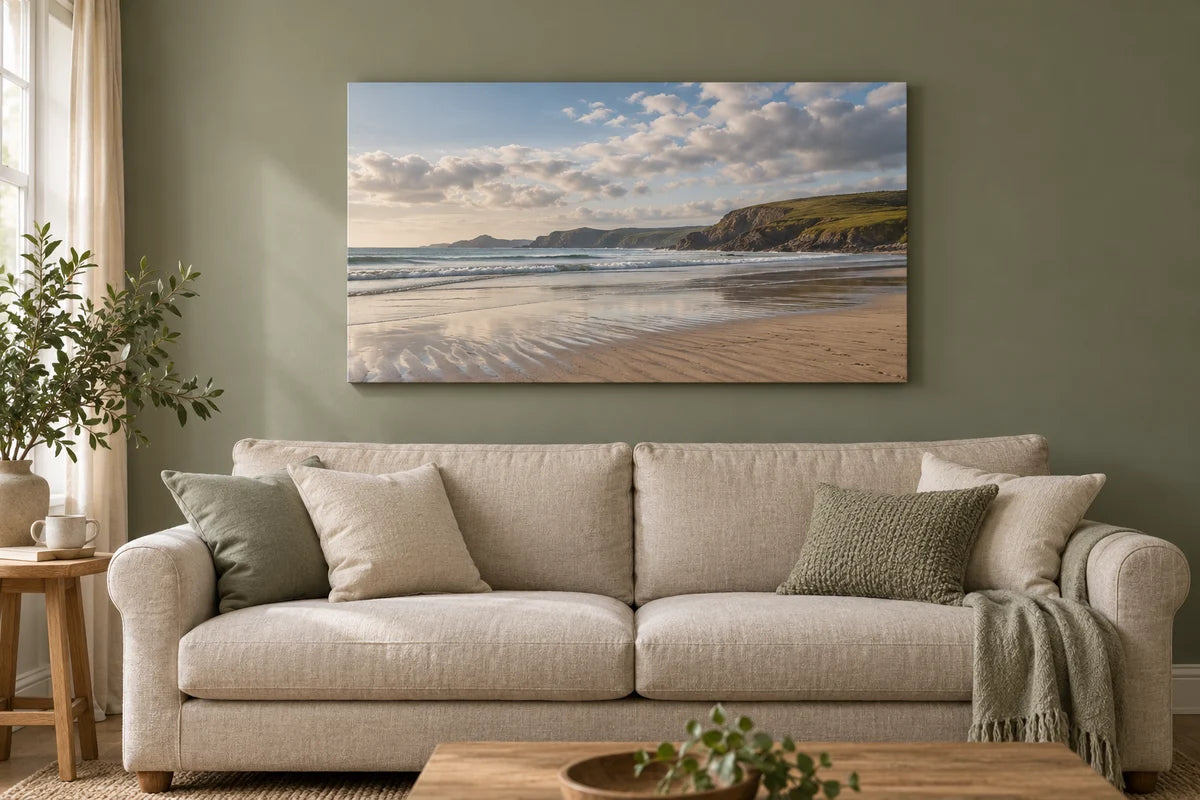
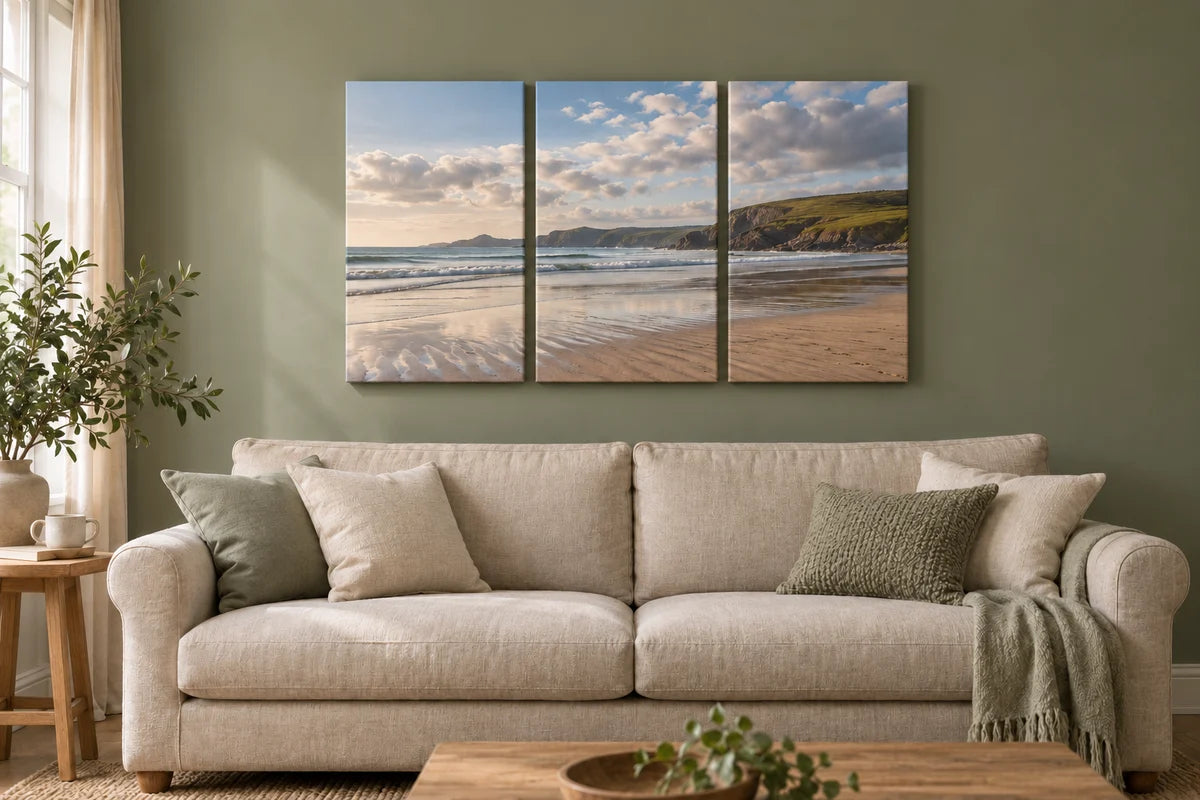
Why can a split canvas have so much impact?
With one canvas, your eye takes in the photograph and its outside edge. With a split set, you also notice the intervals, the repeating edges and the shape made by all the pieces together. The wall becomes part of the arrangement.
A three-panel seascape can make you look across the scene from beach to headland. A square grid can give a broad, quiet section of wall a strong centre. A stepped arrangement can follow the shape of a tree or draw attention to a feature in the middle of a landscape.
That extra presence can be useful above a sideboard, sofa or bed, where there is enough room to see the complete group. It comes from the relationship between photograph, panels and wall space. Adding more panels to an unsuitable crop will not create the same effect.
You can carry a colour from the photograph into a cushion, a nearby pot or a blanket, but the print does not need a roomful of matching accessories. Often the most effective change is giving one good picture some clear space.
Keep the main subject in mind
Landscapes and travel photographs
Wide views often suit a split because the eye can move through them. A shoreline, a line of hills or an open stretch of countryside gives you several places where a panel division may sit comfortably. Check the smaller details too. A horizon can line up while a building, boat or foreground rock is awkwardly divided.
Try the picture in a simple triptych before assuming it needs five or nine pieces. More divisions create a stronger pattern, which may suit the scene or compete with it.
Portraits, pets and family photographs
A close portrait often works well on one canvas because the face stays complete. For a split, look for breathing space around the people or animal and place the joins thoughtfully. An eye, a nose or a small hand at a panel edge can become the first thing you notice.
A family walking through a landscape may offer more freedom than a tightly cropped group photograph. Let the preview help you decide. Keeping a photograph on one canvas is a good choice when that is what respects the picture.
Artwork, lettering and strong lines
Text needs particular care. A join through a letter may make a quote harder to read. Architecture, horizons and straight paths also make small differences in hanging height easier to see. If the image depends on exact uninterrupted lines, compare it carefully as a single print before choosing a split.
Compare the whole display, not the size of one panel
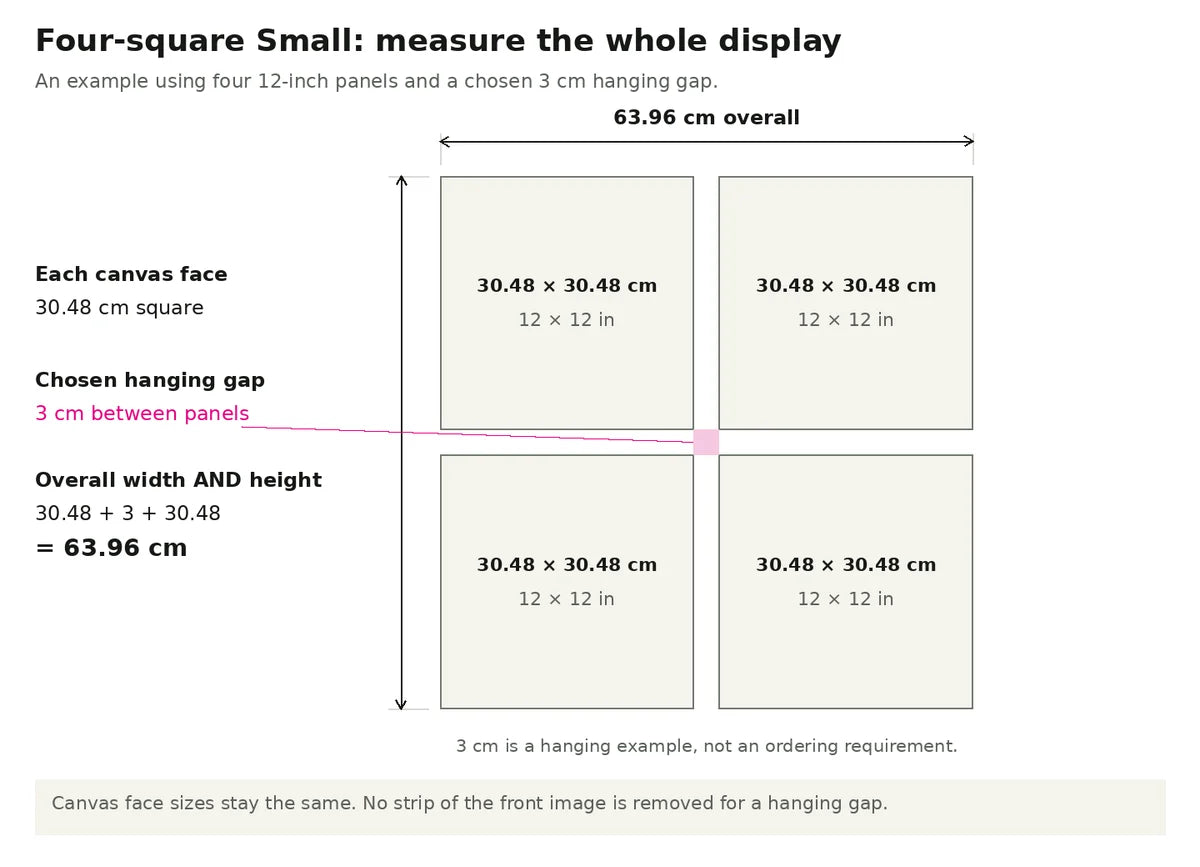
A set described as four 12 × 12 inch canvases is not a 12-inch picture. Each panel is that size. Arranged two across and two down, their front faces make a 24 × 24 inch square before you add the spaces between them.
In centimetres, each 12-inch face is 30.48 cm. Two faces span 60.96 cm. If you choose a 3 cm gap between them, the installed group is 63.96 × 63.96 cm. That 3 cm is a hanging example, not an ordering requirement.
| Set | Each panel | Faces together, before gaps | With a chosen 3 cm central gap |
|---|---|---|---|
| Small | 12 × 12 in / 30.48 × 30.48 cm | 60.96 × 60.96 cm | 63.96 × 63.96 cm |
| Medium | 16 × 16 in / 40.64 × 40.64 cm | 81.28 × 81.28 cm | 84.28 × 84.28 cm |
| Large | 20 × 20 in / 50.8 × 50.8 cm | 101.6 × 101.6 cm | 104.6 × 104.6 cm |
For a row, add the panel widths and every space between them. For a grid, work out the width and height separately. For a stepped set, check the complete outline, including its tallest panel. Our canvas and poster size guide is useful when comparing individual print sizes.
Before ordering, mark out the proposed display with paper templates or another method suitable for your wall finish. View it from the doorway and from where you normally sit. Look at the space around the picture as well as the area it fills. Our guide to canvas sizes above a sofa goes into that relationship in more detail.
What changes when you hang a split set?
A single canvas gives you one object to position. A split set gives you several. Matching levels, panel order and consistent spacing take a little more thought, particularly when a horizon crosses the arrangement.
Lay out the order safely first, use your whole-set reference and check it before making holes. Choose fixings suitable for the actual wall, print weight and hanging system. Follow the fixing manufacturer's instructions rather than assuming one method suits every surface.
Our creator keeps adjoining parts of the chosen crop on the panel fronts. It does not remove image strips to account for hanging gaps. You choose the spaces at home; those spaces change how a line travels across the empty wall, but they do not change the photograph already printed on the canvases.
Single canvas and split canvas, side by side
| Consideration | One canvas | A split set |
|---|---|---|
| The picture | One uninterrupted front. | One photograph divided across separate fronts. |
| The effect | The subject and outside shape lead. | The panel rhythm and hanging spaces also become part of the display. |
| Crop checks | Check the outside edges and sides. | Check every internal join as well as the outside crop and sides. |
| Measuring | Use the finished print dimensions. | Add the panel dimensions and your chosen hanging gaps. |
| Hanging | One piece to position. | Several pieces to position and align. |
| What you order | One individual canvas. | One complete set, with its panel count and full price shown. |
Compare the full quoted prices for the size and finish you actually want. A small single canvas and a large multi-panel display are different purchases. The useful comparison includes the picture area, hanging footprint, finish and any extras, rather than just two starting prices.
What about 3 for 2?
One complete split set counts as one qualifying product. You can mix it with eligible canvas prints or posters, and the lowest-priced qualifying complete product is free when the basket contains three. The panels within a set do not become separate qualifying purchases; the quoted set price is already the total for all its panels.
Which would we choose?
For a close photograph of somebody you love, we would start by looking at it on one canvas. For a landscape you want to make a feature of, we would try a simple split and see whether the divisions add to it. For a broad square area of wall, we would also compare the four-square layout.
None of those is a rule. The most useful thing you can do is look at your own photograph in the creator, with the actual panel sizes in mind. If it looks better complete, keep it complete. If the split gives it a presence you love, you have found your set.
Explore single canvas prints or try the split canvas layouts. For the steps, finishes and ordering details, meet our split canvas creator.
Common questions
Will a split canvas make my room look bigger?
It can give a photograph more presence and draw attention across a wall. It does not guarantee a room will feel larger. The display's scale, surrounding space, furniture and the photograph itself all matter.
Do I need a different photograph for every panel?
No. A split set uses one photograph. Several different photographs belong to a gallery arrangement or collage instead.
Can I choose the gaps at home?
Yes. Allow for them in your wall measurements and try the arrangement before fixing it. Preview gaps are illustrative and do not remove strips of the source photograph.
Is a split always the better choice for a large wall?
No. One large canvas can make a strong focal point. Choose a split because you like what the arrangement does for the picture, as well as because it fits the wall.